Resources
26 resources from communities on Kannect Discover


Certificate of Origin
Certificate of OriginThe South Salt Lake Chamber of Commerce provides Certificate of Origin services to help local businesses navigate international shipping and export requirements.About This ServiceWhat is a Certificate of Origin? A Certificate of Origin (CO) is an official document that identifies the country where a product or commodity was manufactured or produced. It may be required by customs authorities, international trade partners, or trade agreements to determine applicable duties, tariffs, and other import requirements. The South Salt Lake Chamber of Commerce can certify Certificates of Origin for eligible businesses, providing important documentation to support international trade and export transactions.Processing TimeStandard Processing: 2–3 business daysRush Processing: Same-day service may be available for an additional fee.Why You Need a Certificate of OriginSupporting Your International Trade - Whether you're exporting products to a neighboring country or shipping goods across the globe, accurate documentation can help prevent unnecessary delays and support a smoother customs process.International Trade Documentation - Obtain the documentation you need to support the export of goods to international markets.Chamber Certification - Receive Chamber-certified documentation for use with international customers, customs authorities, and other trade partners.Help Avoid Delays - Properly completed export documentation can help facilitate customs clearance and reduce potential shipping delays.PricingChamber Members - Free, based on membership package (Unlimited pages)Non-Members - $25 (Per page)Same-day processing — Non-Members +$15Request a Certificate of OriginReady to request a Certificate of Origin? Contact the South Salt Lake Chamber of Commerce to begin the process and learn what documentation you'll need to provide.Request a Certificate of Origin
Read →
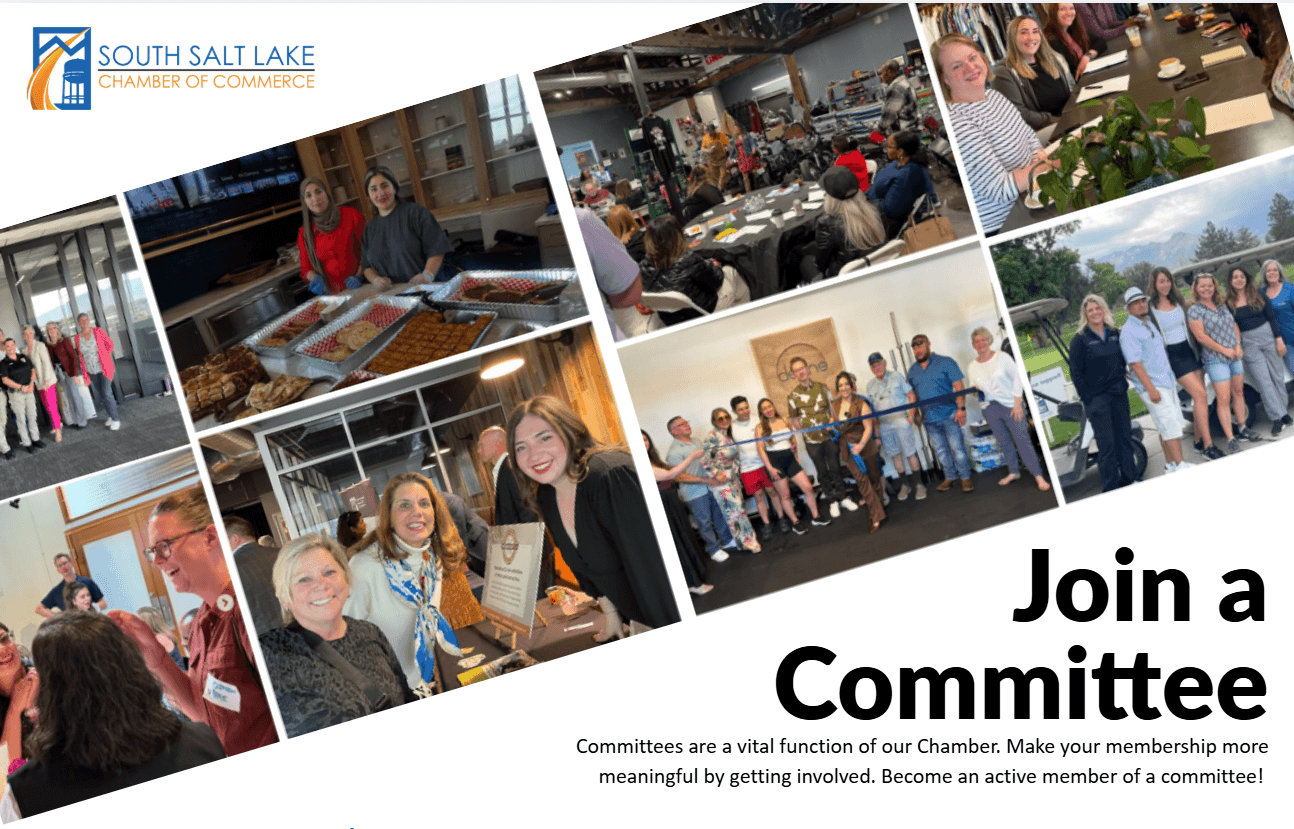
Join a Committee
Committees are a vital function of our Chamber. Make your membership more meaningful by getting involved. Become an active member of a committee!
Read →

Doing Business in the City of South Salt Lake
Congratulations on opening or growing your business in South Salt Lake! We know there is a lot to navigate when you're running a business, and our goal is to make it easier.Whether you're opening your doors for the first time, expanding your operations, or relocating to our city, this guide will help connect you with the people, departments, and resources available to support your success.South Salt Lake is proud to be home to a diverse, innovative, and entrepreneurial business community. We believe local businesses are the foundation of a thriving city, and we're committed to helping you stay informed, connected, and engaged.Know the Rules (and Where to Find Them)Understanding your property's zoning and applicable city regulations can save you time, money, and frustration as your business grows.Whether you're planning to install a new sign, host an event, renovate your space, expand your operations, or simply want to understand what's permitted at your location, these resources are a great place to start.Use the links provided to access:South Salt Lake Municipal CodeZoning MapPlanning & Zoning ApplicationsBuilding ApplicationsKnow Who to ContactThe City of South Salt Lake has dedicated staff ready to help answer questions and connect you with the right resources.Whether you have questions about permits, inspections, public safety, economic development, licensing, or city services, knowing who to contact can save valuable time and help your business move forward.Quick links include:Economic DevelopmentCommunity DevelopmentSouth Salt Lake Police DepartmentSouth Salt Lake Fire DepartmentKnow Your Local LeadershipUtility ServicesLocal government helps shape the future of our business community.Understanding who represents your district, when City Council and Planning Commission meetings take place, and how public decisions are made gives you the opportunity to stay informed and participate when issues affect your business.You don't have to attend every meeting, but staying connected helps ensure your voice is heard.Use the links provided to find:Your City Council RepresentativePublic Meetings & NoticesPlanning Commission InformationRunning a business doesn't mean you have to do everything on your own.There are numerous organizations throughout South Salt Lake and Utah that offer free or low-cost business advising, financing opportunities, educational workshops, networking events, certifications, and technical assistance.Take advantage of these resources to strengthen your business and continue growing.Featured resources include:Utah Microloan FundThe SSL Co-OpThe Mill Entrepreneurship Center Get Involved in Your CommunitySome of the strongest businesses are those that become part of the community around them.South Salt Lake offers countless opportunities to connect with residents, support local initiatives, collaborate with other businesses, and showcase what you do.Whether you're participating in Mural Fest, joining community celebrations, volunteering with Promise South Salt Lake, or engaging with the City's Creative Industries program, your involvement helps strengthen both your business and our community.Explore the links provided to learn more about:SSL ArtsPromise South Salt LakeCity EventsWe're Here to HelpThe South Salt Lake Chamber of Commerce and the City of South Salt Lake are committed to helping businesses succeed. We hope this guide becomes a helpful resource as you build your business, make connections, and become part of our growing community.Welcome! We're glad you're here.
Read →

Chamber Membership Package
Discover everything you need to know about becoming a member of the South Salt Lake Chamber of Commerce. This guide outlines each membership level, from Connect to our Community Investment tiers, along with the benefits and opportunities available at every level. Whether you're joining for networking, visibility, advocacy, or business growth, this guide will help you choose the membership that's the best fit for your organization.
Read →

Celebrate Your Milestone with a Ribbon Cutting
Celebrate your business with the South Salt Lake Chamber! If you're interested in hosting a Ribbon Cutting to celebrate a grand opening, new location, expansion, milestone, or other special occasion, we'd love to help.Chamber Members: FreeNon-Members: $65The Ribbon Cutting package includes coordination with the Chamber, event promotion, and a ceremonial ribbon cutting with Chamber representatives.Interested in hosting a Ribbon Cutting?Fill out the Ribbon Cutting Interest FormA member of the South Salt Lake Chamber team will follow up with you to discuss next steps and available dates.
Read →

Shop Local — South Salt Lake
Explore South Salt LakeSouth Salt Lake is one of Utah's most vibrant and diverse communities—a city where cultures, creativity, entrepreneurship, and opportunity come together. Ideally located in the heart of the Salt Lake Valley, South Salt Lake offers unparalleled access to major freeways, public transit, downtown Salt Lake City, the University of Utah, Salt Lake International Airport, and world-class outdoor recreation. Whether you're here for a few hours or have called South Salt Lake home for years, you'll quickly discover a community full of character, innovation, and local pride.What truly makes South Salt Lake special is its people and its businesses. From family-owned restaurants and neighborhood coffee shops to artisan makers, retailers, breweries, service providers, and innovative startups, our local businesses are the heartbeat of our community. Every purchase made at a local business helps create jobs, strengthens our neighborhoods, fuels our local economy, and keeps dollars circulating right here in South Salt Lake.At the South Salt Lake Chamber of Commerce, we believe that supporting local is an investment in our community's future. When we choose to shop, dine, and do business locally, we're helping entrepreneurs pursue their dreams while building a stronger, more connected city for everyone.To help you discover all that South Salt Lake has to offer, we've compiled a guide featuring just a fraction of the incredible businesses that call our city home. Whether you're looking for your next favorite restaurant, a unique shopping experience, professional services, or hidden local gems, this guide is a great place to start.Download our South Salt Lake Business Guide for an easy, go-anywhere resource that highlights businesses we encourage our community and visitors to explore and support.Discover the Stories Behind the StorefrontsEvery business has a story, and every entrepreneur has a reason they chose South Salt Lake. If you'd like to go beyond the directory and get to know the people, passion, and purpose behind our local businesses, we invite you to explore Salt Lake Sideways.Salt Lake Sideways is a storytelling initiative that celebrates the businesses, artists, makers, and entrepreneurs shaping the unique identity of South Salt Lake. Through interviews, features, and behind-the-scenes stories, you'll discover the heart and soul of our community while finding new places to visit, support, and share with others.Whether you're a resident looking to rediscover your neighborhood or a visitor searching for authentic local experiences, Salt Lake Sideways offers a deeper connection to the businesses that make South Salt Lake unlike anywhere else.We invite you to explore, shop local, support small, and experience everything South Salt Lake has to offer.
Read →


Family Advocate
Family Advocates work with our community to create goals, plans, and action steps. Have an idea of what you would like support with? Just ask!Summer Services FormExamples of support offered:Getting a drivers licenseConnecting to our housing teamConnecting to our clinical teamBenefits troubleshootingMeet the team!Cruz Pedraza-Ruizcpedrazaruiz@flocritco.org303-929-9875 Lupe Floresgflores@flocritco.org303-929-4714Hezekiah Carlstromhcarlstrom@flocritco.org303-929-5475Alex Madeusamadeus@flocritco.org720-957-1820Sabrina OlsenSolsen@flocritco.org720-948-9216Amanda Pombarapombar@flocritco.org720-948-6899
Read →
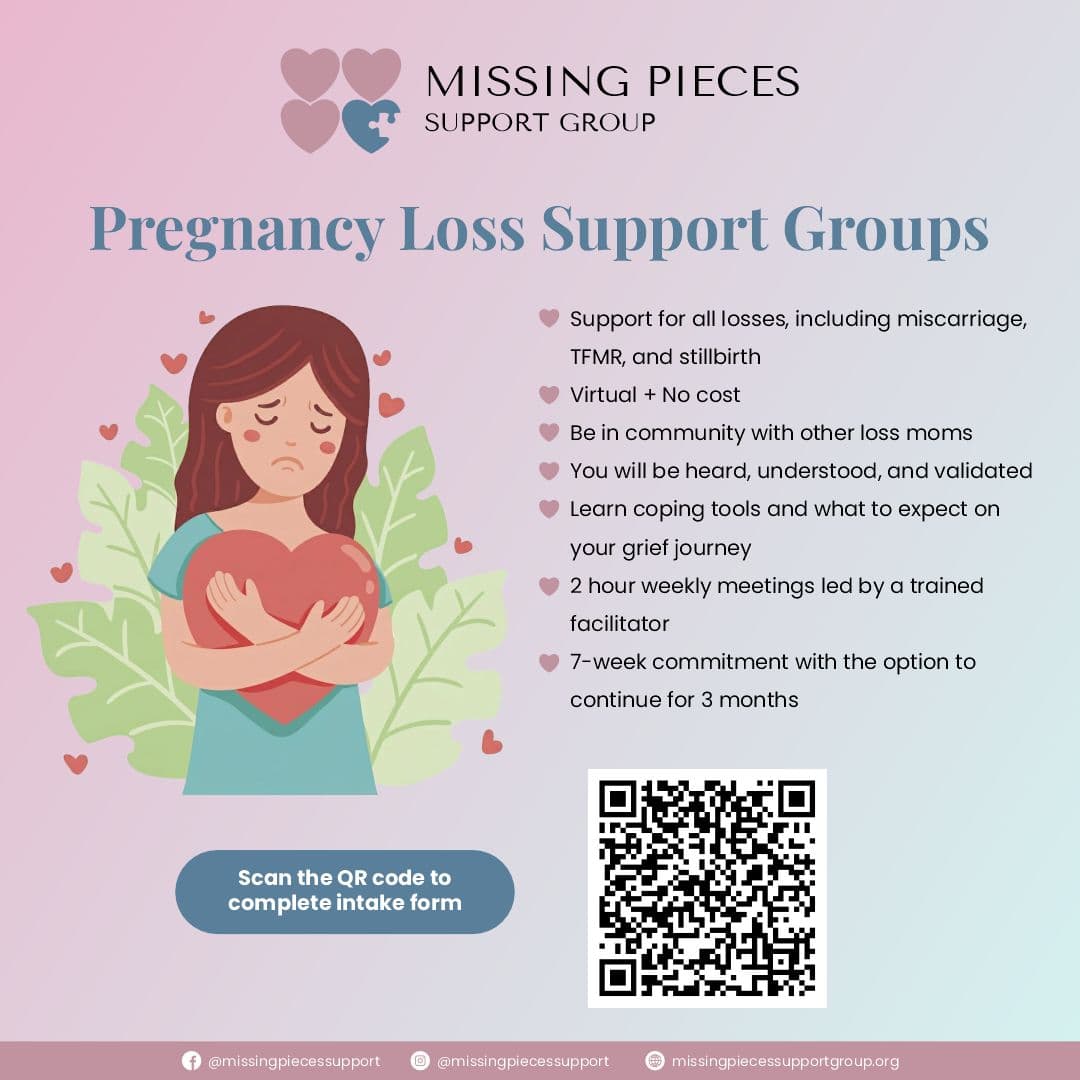

Pregnancy Loss Support Group
Our Pregnancy Loss Support Groups offer a 7-week virtual program that provides structured grief support and coping strategies for parents after pregnancy or infant loss, in a small, safe group setting. At the end of the 7-week period, cohorts have the option to continue connecting socially for an additional 3 months, fostering trust, shared healing, and meaningful peer relationships.
Read →
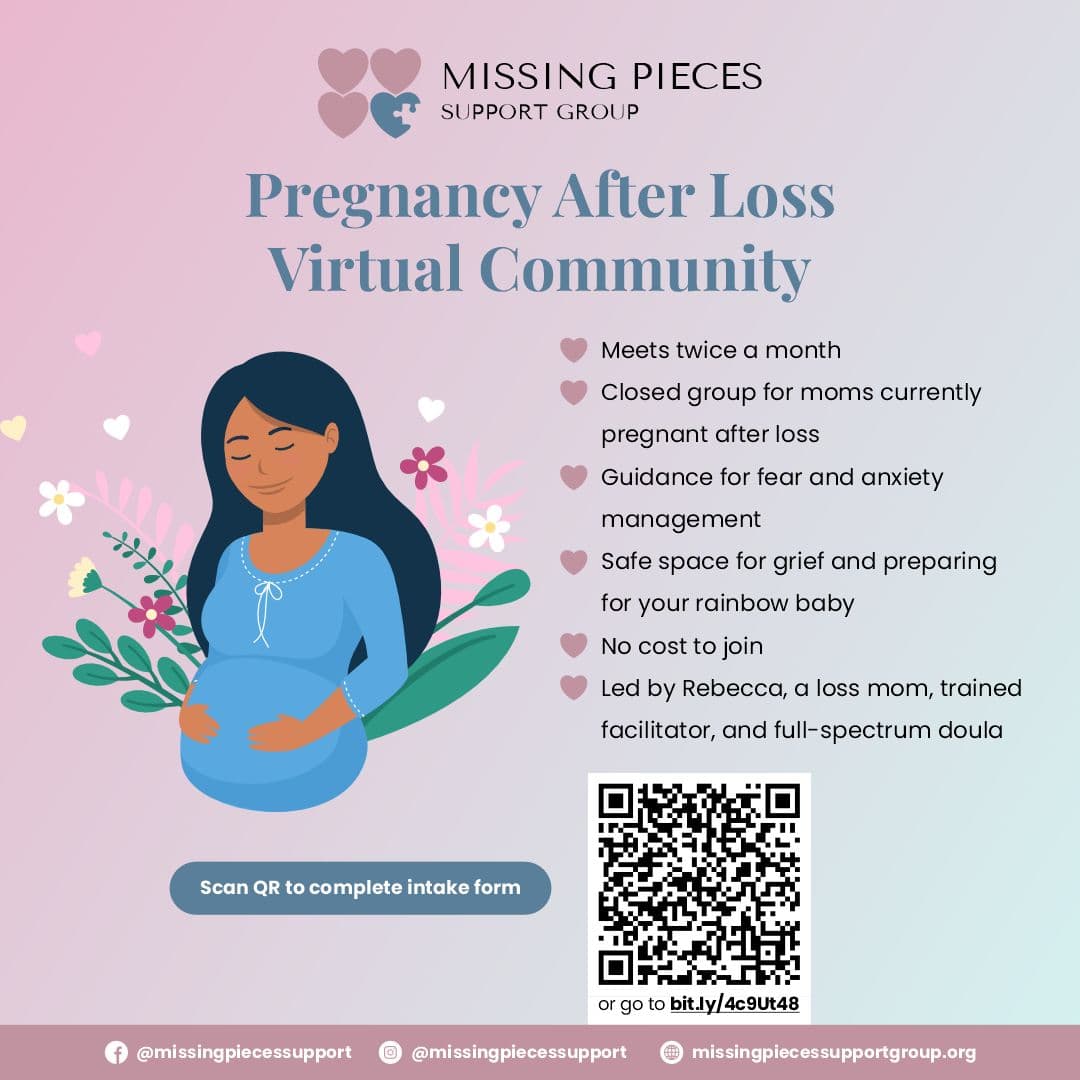
Pregnancy After Loss Virtual Community
Our Pregnancy After Loss Virtual Support Groups aim to provide dedicated, stage-specific support during the subsequent pregnancy and postpartum period. PAL Pods provide ongoing guidance and understanding as you navigate the complex emotions of pregnancy after loss.
Read →
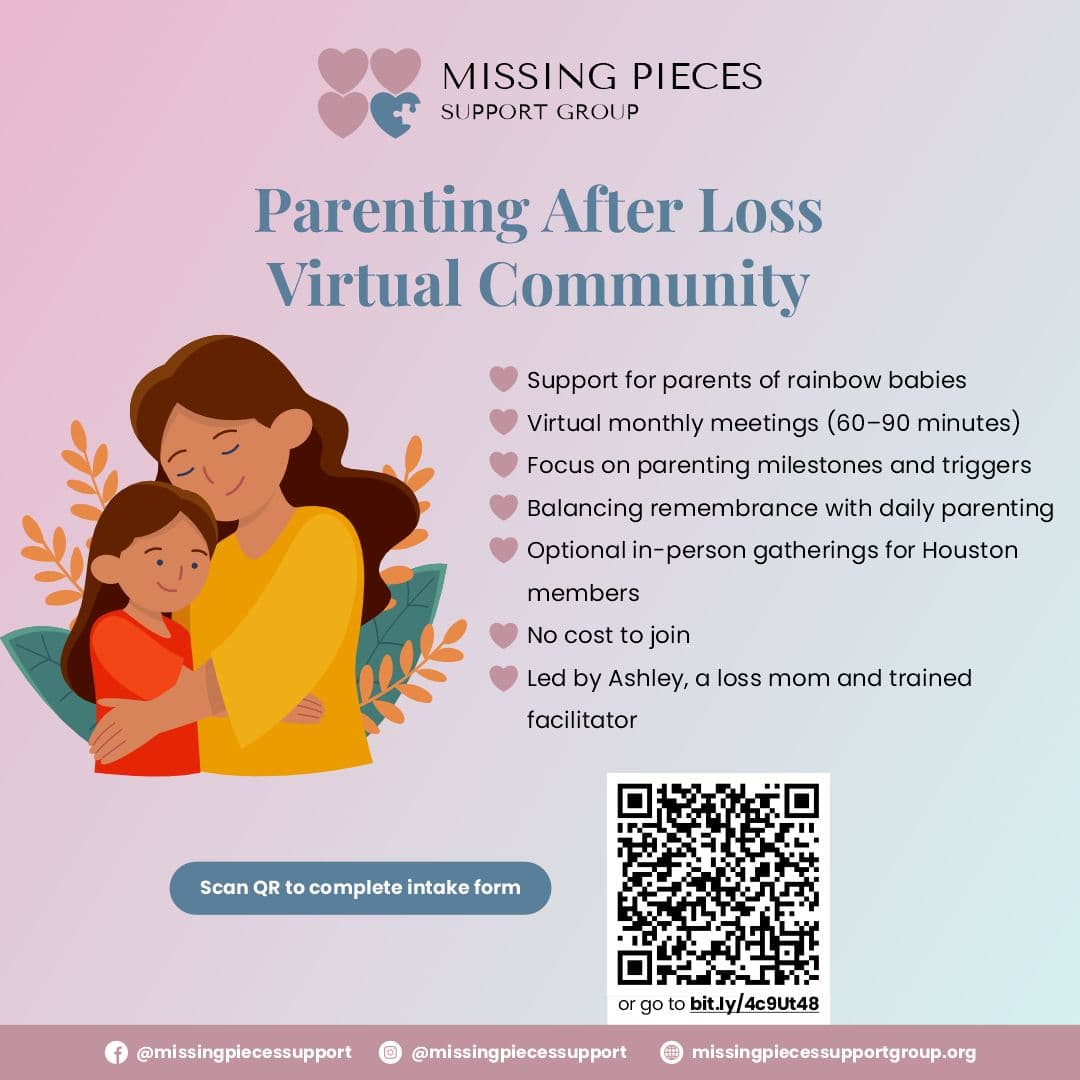
Parenting After Loss Virtual Community
Our Parenting After Loss Support Groups aim to support mothers and families who have experienced pregnancy or infant loss and are now parenting a rainbow baby. This group provides a safe and nurturing space where grief and gratitude can coexist, and where families can honor the child they lost while embracing life with their child born after loss.
Read →
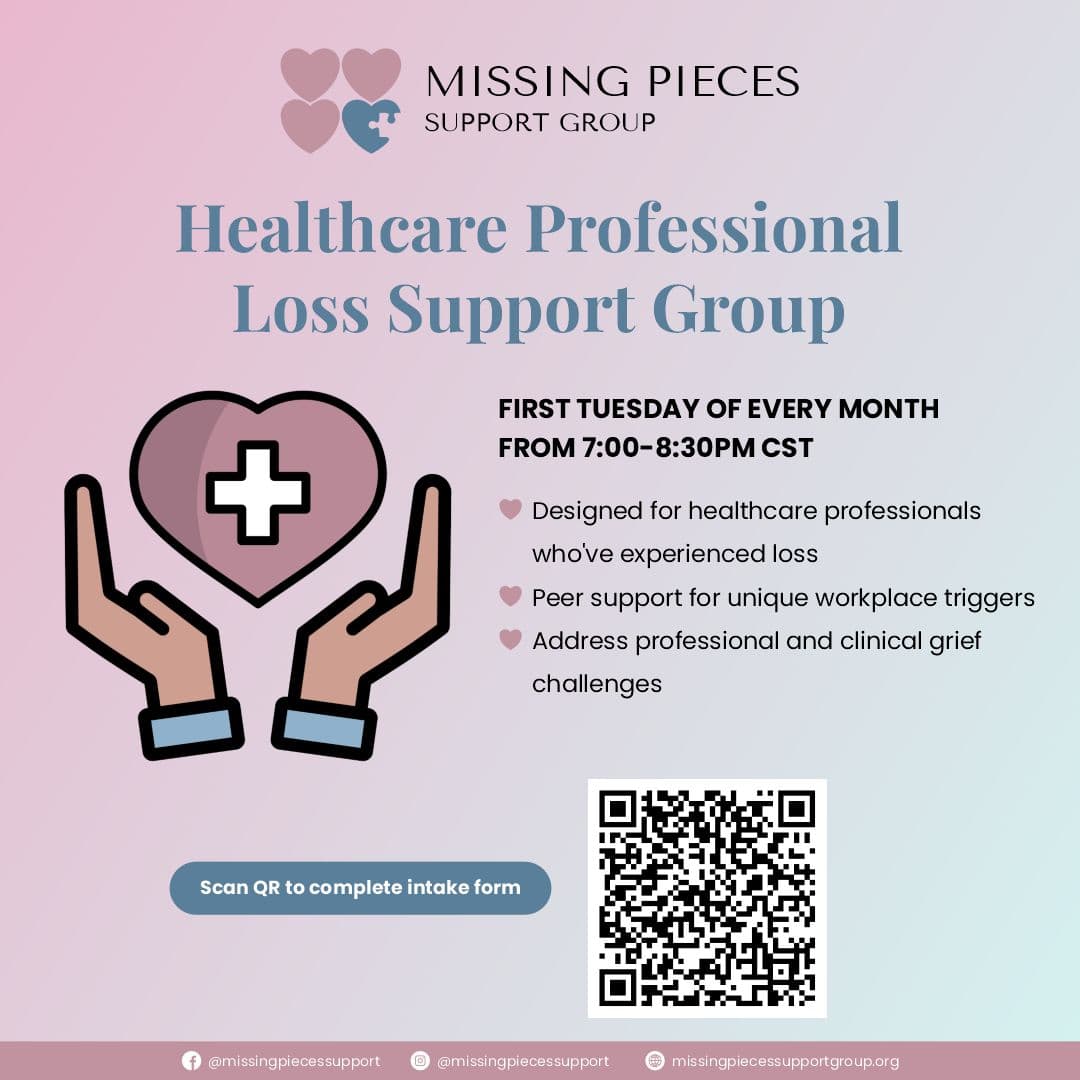
Healthcare Professional Loss Support Group
Healthcare Professional Loss Support Groups are meant to provide a dedicated space for healthcare workers who have experienced pregnancy or infant loss to connect with peers who understand the unique intersection of professional caregiving and personal grief. This monthly virtual group offers compassionate, non-judgmental support for those who spend their days caring for others while navigating their own loss.
Read →
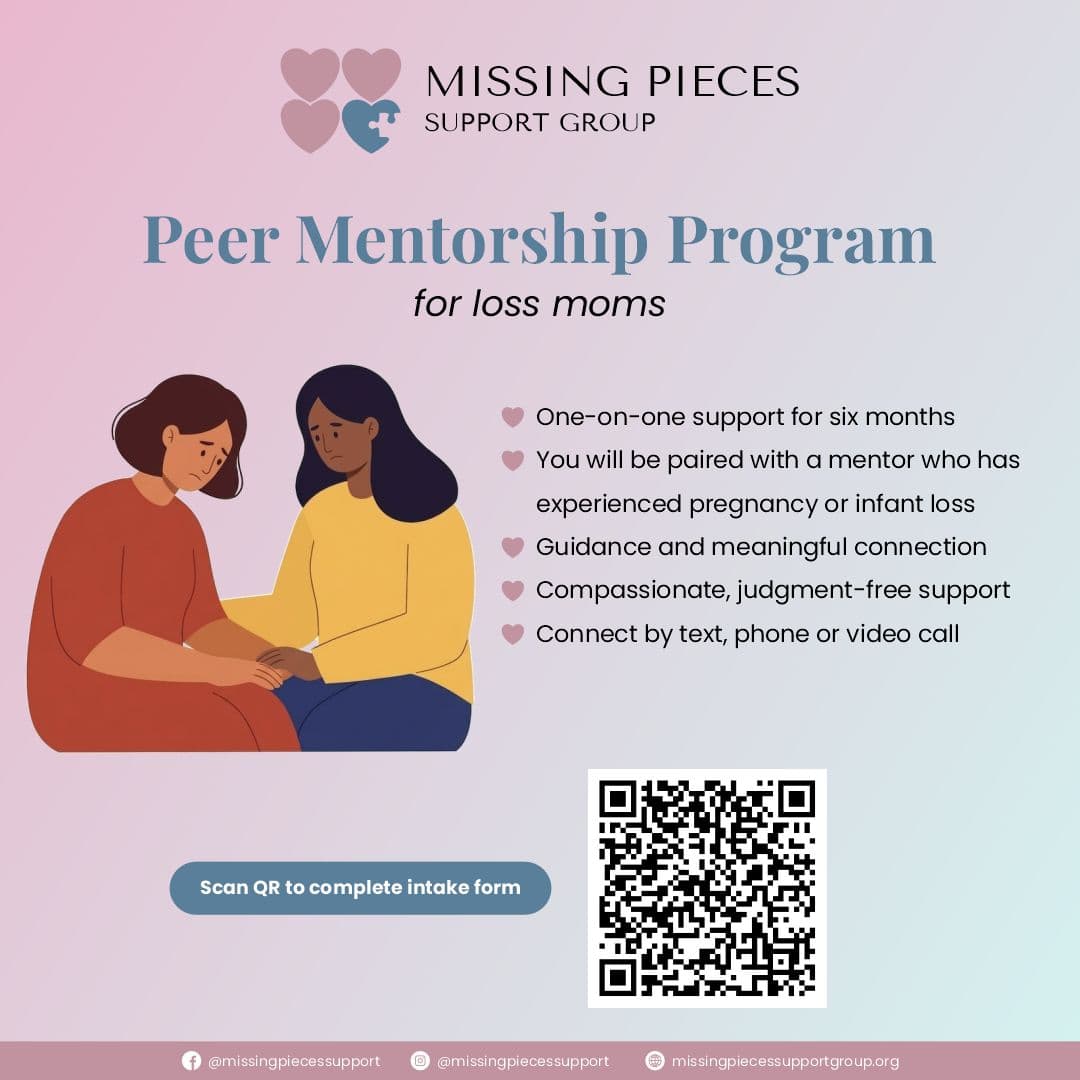
Peer Mentorship Program
Our Peer Mentorship Programs are meant to offer personalized, compassionate companionship through shared experience. Peer Mentorship can begin before a cohort starts, run alongside group programs, or continue afterward — providing continuity of care and deeper connection throughout the journey.
Read →
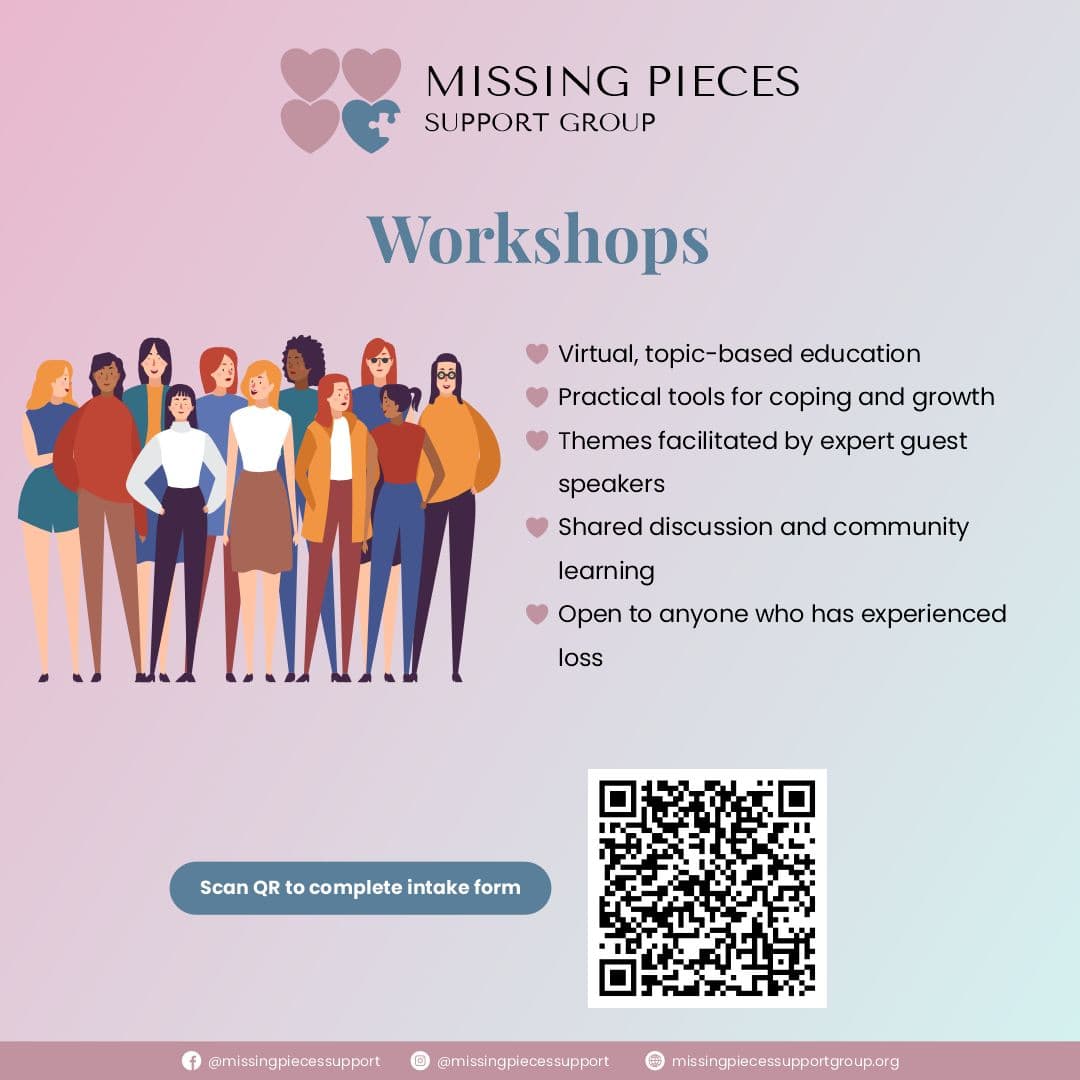
Workshops
Our workshops aim to offer virtual, topic-based education and community learning to anyone who has experienced pregnancy loss. Workshops may include specific themes, guest speakers, practical tools for coping and growth, and/or shared learning and discussion.
Read →
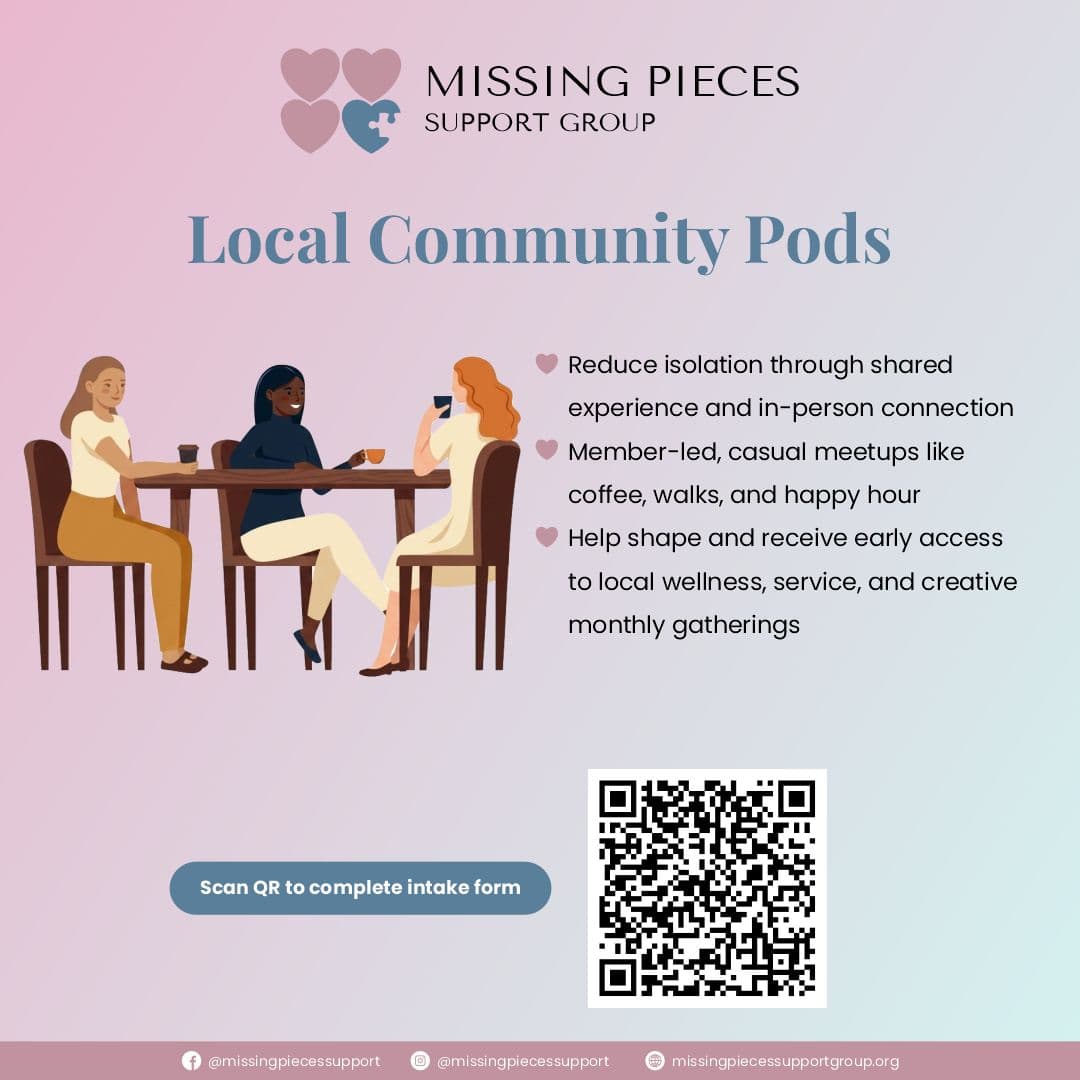
Local Community Pods
Our Local Community Pod events aim to build sustainable local communities and reduce isolation through informal meetups and structured in-person gatherings. Meetups will be organized through private local social groups (Facebook) and will be posted here and on our website events page (https://missingpiecessupportgroup.org/events/). They are currently available only in the Houston area.
Read →


Spring Band Concert
Test resource.
Read →
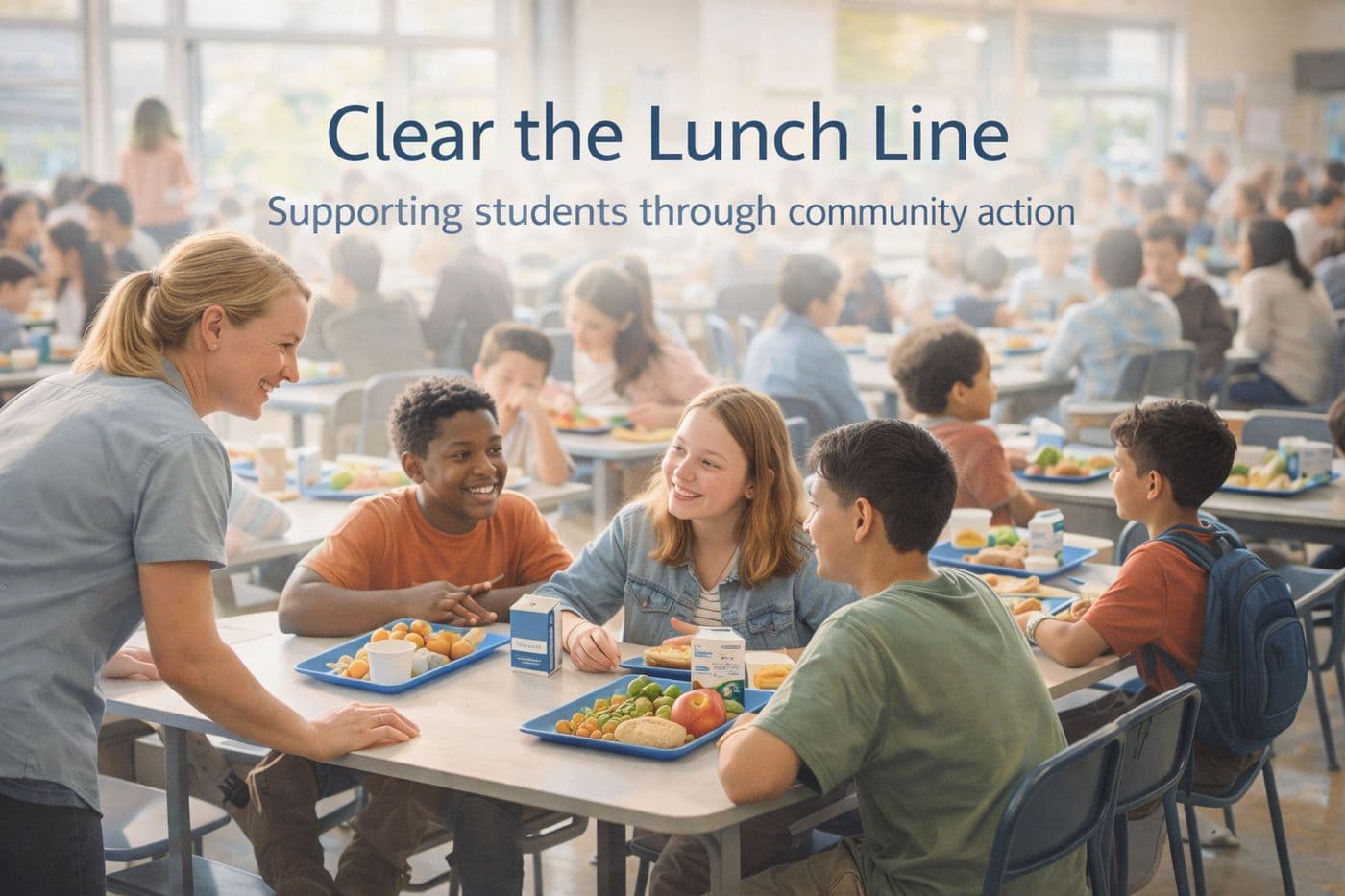

Why School Lunch Debt Matters and How Communities Can Help
Across the United States, millions of students rely on school meals every day. For many families, these meals provide consistent nutrition that helps children stay focused, energized, and ready to learn. But for some families, unexpected financial challenges can lead to unpaid meal balances, commonly referred to as school lunch debt.School lunch debt occurs when a student receives meals at school but the family account does not have enough funds to cover the cost. Over time, these balances can grow and create stress for families and administrative burdens for schools.Clear the Lunch Line was created to help communities step in and support students by paying down these balances so that children can focus on learning instead of worrying about unpaid meals.Why School Meals Are ImportantAccess to nutritious meals during the school day has been shown to support both academic performance and student well being. According to research from organizations working in child nutrition, students who have access to reliable meals are more likely to stay engaged in class and perform better academically.School meal programs also play an important role in supporting families by helping reduce daily food costs and ensuring children receive balanced nutrition during the school week.Understanding School Lunch DebtLunch debt can happen for many reasons. Families may experience temporary financial hardship, changes in employment, unexpected medical expenses, or other challenges that make it difficult to keep meal accounts fully funded.Schools typically work closely with families to resolve balances, but unpaid meal accounts can still accumulate over time. In some districts across the country, schools collectively carry thousands or even millions of dollars in unpaid lunch balances.Community driven efforts can help relieve this burden and support both families and schools.How Communities Can HelpOne of the most effective ways to address lunch debt is through local community support. When individuals, organizations, and businesses contribute to targeted fundraising campaigns, those funds can go directly toward clearing meal balances for students.Clear the Lunch Line works with community members and schools to organize campaigns that raise funds to pay off these balances in a transparent and respectful way.Even small contributions can make a meaningful difference when communities work together.Helpful ResourcesIf you would like to learn more about school meals and child nutrition programs, the following resources provide helpful information.USDA National School Lunch Program: https://www.fns.usda.gov/nslpNo Kid Hungry: https://www.nokidhungry.orgFeeding America: https://www.feedingamerica.orgFRAC School Meal Programs Overview: https://frac.org/programs/national-school-lunch-programThese organizations provide research, policy information, and resources related to school meals and child nutrition across the United States.Moving Forward TogetherEvery student deserves the opportunity to learn in a supportive environment where basic needs are met. By working together, communities can help ensure that unpaid meal balances do not stand in the way of students receiving the meals they need during the school day.Clear the Lunch Line is committed to helping communities organize around this goal through local campaigns that directly support schools and families.When communities come together, small acts of support can create lasting impact for students.
Read →


The Architecture of International Justice: From Classical Philosophy to Administrative Integrity
International law did not emerge from technical necessity. Instead, it arose from moral ambition. When we look from the early modern articulation of the law of nations to contemporary treaty systems, we see that the international legal order has always reflected humanity’s attempt to discipline power through reason. However, the enduring challenge is not the absence of rules. Rather, it is the preservation of integrity in their application.Hugo Grotius, often regarded as a foundational architect of international law, framed the jus gentium as rooted in both natural law and the consent of states. In his view, sovereign entities were bound not merely by strategic interest but also by moral obligation. Furthermore, war itself was not beyond legal evaluation. It was subject to standards of justice. Grotius’s vision assumed that rational states could recognize reciprocal constraints as mutually beneficial.Immanuel Kant advanced this aspiration in Perpetual Peace, arguing that stable international order depends upon republican governance, transparency, and what he famously termed the “transcendental principle of publicness.” According to Kant, any political maxim that cannot withstand public disclosure is inherently unjust. Secret intentions, hidden reservations, and manipulative diplomacy undermine the very trust upon which peace depends. For Kant, legitimacy is inseparable from publicity; justice must survive exposure.John Rawls later reformulated these ideas into a modern “Law of Peoples,” shifting the focus from sovereign competition toward a society of peoples committed to human rights and political reasonableness. Rawls insisted that international legitimacy requires more than formal treaty compliance. It demands that states justify their actions through public reason or arguments that other reasonable people could accept. Justice, therefore, becomes an intersubjective moral enterprise rather than a mere aggregation of negotiated texts.The tension between text and principle is precisely where Ronald Dworkin’s theory of “law as integrity” becomes indispensable. Dworkin rejected the “plain-fact” view that law is simply what legislatures have written or what treaties explicitly contain. Law, he argued, is an interpretative practice. Judges and officials are not technicians applying inert commands; they are authors in a “chain novel,” responsible for ensuring that each decision coheres with the community’s broader narrative of justice.This interpretative responsibility is not an invitation to arbitrary discretion. On the contrary, integrity constrains interpretation by demanding coherence. Every decision must fit and justify the existing structure of principles. In hard cases, where texts are silent or ambiguous, the task is not to invent policy preferences, but to identify the interpretation that makes the legal system morally intelligible as a whole.The practical relevance of this philosophical architecture becomes clear when examining modern treaty regimes. The Geneva Conventions codify humanitarian limits on warfare, protecting civilians and regulating the treatment of prisoners of war and detainees. The Vienna Convention on Diplomatic Relations establishes privileges and immunities not as personal rewards but as functional necessities to ensure the effective performance of diplomatic missions. These instruments embody a moral narrative: sovereignty exists within a framework of reciprocal accountability.Yet institutional dysfunction reveals how fragile this narrative can be. Contemporary analyses, including Gabriel Grisostolo’s work on administrative integrity, demonstrate how formally robust systems may conceal functional impunity. When oversight mechanisms are weak, when political interference distorts judicial independence, or when procedural tools are selectively applied, the appearance of legality can mask substantive injustice. This is not a failure of text; it is a failure of integrity.The danger is symmetrical. The same interpretative sophistication that allows courts to prevent injustice can, in compromised environments, rationalize it. When discretion is detached from principled coherence, law risks becoming an instrument of faction. Kant warned that political actors who rely on secrecy and strategic manipulation erode the trust necessary for peace. Dworkin warned that abandoning integrity transforms law into a mechanical or opportunistic exercise. Rawls warned that institutions lacking public reason lose moral authority.The lesson is not cynicism. It is vigilance.A better international system does not require abandoning treaty frameworks; it requires deepening their interpretative integrity. Constructive interpretation should guide international tribunals when confronting ambiguous mandates. Public reason should discipline state conduct, ensuring that internal practices align with international commitments. Transparency mechanisms and digital compliance structures can operationalize Kant’s principle of publicness, transforming philosophical insight into administrative architecture.International law must be understood not as a static rulebook community, but as a community of principles. Sovereign equality, humanitarian protection, and diplomatic functionality are not merely negotiated conveniences; they are expressions of a shared commitment to reciprocity and accountability. Where interpretation is guided by integrity, law restrains power. Where integrity collapses, law becomes its camouflage.The future of international justice depends on recognizing this dual potential. Law is neither inherently emancipatory nor inherently oppressive. It is a structured social practice whose moral direction depends on the fidelity of its interpreters. If administrators and judges act as mere custodians of text, the system stagnates. If they act without principled coherence, it corrodes. Only when they act as authors of integrity, seeking the best justification of their legal tradition, does the empire of law remain worthy of allegiance.In the end, the stability of the international order rests not only on treaties and institutions, but on the moral discipline of those entrusted to interpret them. Transparency, reciprocity, and ethical coherence are not rhetorical ideals; they are structural necessities. Without them, international law becomes an empty slogan. With them, it remains humanity’s most ambitious attempt to civilize power.
Read →


Why Strong Communities Are Built on Connection, Not Technology
Strong communities are not built by tools alone. They are built by people who feel seen, heard, and connected to something larger than themselves.In a world filled with notifications, platforms, and endless digital noise, it is easy to assume that more technology automatically leads to better engagement. In reality, the opposite is often true. Communities struggle not because they lack tools, but because they lack clarity, trust, and meaningful opportunities to connect.Connection begins with communication that feels intentional rather than overwhelming. When people understand what is happening, why it matters, and how they can participate, engagement follows naturally. Communities thrive when members feel informed without feeling flooded.Equally important is creating space for contribution. Strong communities invite participation in many forms, whether that means attending an event, sharing a resource, volunteering time, or simply joining a conversation. When members see that their presence matters, they are far more likely to stay involved.Technology plays a supporting role in this process. The right tools make communication easier, participation more accessible, and coordination more efficient. However, the technology should never overshadow the mission. The most successful communities use technology quietly, allowing connection and purpose to remain at the center.At The Bridge Collective, we believe that community is not about scale for the sake of growth. It is about building relationships that last, fostering trust through transparency, and creating rhythms of engagement that people actually enjoy.When connection leads, community follows.
Read →

This is an Article.
Can this be used for announcements?
Read →


Announcenment
Welcome to the Carleton University Research Hub This is an online community designe tpo bring together researchers from all disciplines are invited to together to collaborate, experiment, and innovate. Whether you’re in engineering, business, policy, or the arts, our hub provides an opportunity to connect with peers, industry partners, and mentors who want to have cross-disciplinary discussions, create collaborative teams, and explore new research opportunities. The hub makes it easy to exchange knowledge, test ideas, and accelerate innovation. By joining the hub, you can get the latest news on upcoming workshops, mentoring opportunities and networking events. Our goal is to bridging together talent, and experience by encouraging students, researchers and, the public to explore new ideas, develop practical skills, and build a stronger research community.
Read →
Pregnancy Loss Support Part IV: Jescekia’s Pregnancy Loss Story
Welcome back to the fourth and final part of our series on pregnancy loss support. Today, we will be hearing Jescekia’s pregnancy loss story. Jescekia is a co-founder of the non-profit organization Missing Pieces Support Group where women going through pregnancy loss can find free support and resources. Over the past few weeks, we have had the pleasure of getting to know Missing Pieces along with its co-founders, Jamilah Robinson, Emily Gamboa and Jescekia Sam. All of these women had their own unique experiences with pregnancy loss. As a result, they were inspired to join together to create an organization that would provide much-needed support for other grieving moms. So far in our series, we have learned about the support offered by Missing Pieces and how women can access that support. We have heard Jamilah’s pregnancy loss story. And we have heard Emily’s pregnancy loss stories. Today, we are going to wrap up by hearing Jescekia’s pregnancy loss story. If you have not already read the other three parts to this series, you can find all of them here:Pregnancy Loss Support Part I: A New Resource for Grieving MomsPregnancy Loss Support Part II: Jamilah’s Pregnancy Loss StoryPregnancy Loss Support Part III: Emily’s Pregnancy Loss StoriesAfter checking out those other posts, come back to this one so you don’t miss Jescekia’s pregnancy loss story.Hey Mama, if you find my blog posts helpful, would you help support this blog by making product purchases through the links on this page? It will not cost you any extra but the commissions I receive as an Amazon and brand affiliate help to cover the costs of operating this blog so that I can keep it running ad-free. Thank you so much for your support. You are literally the reason this blog was started and the fuel that motivates me to keep it going!Jescekia’s Pregnancy Loss StoryMama Rissa: What was your journey like leading up to your pregnancy?Jescekia: I was already a mother of 2 sons from a previous relationship. My husband and I finally decided to create life from our union, especially given the health of his mom. The day that I removed my IUD was the same day my Mother-in-law passed away.Mama Rissa: How and when did you find out you were pregnant?Jescekia: After Trying for 6 months, we finally conceived. I was using an app to track things and took a home pregnancy test in the month of June, 2017. It was positive. I waited until Father’s Day to share the news with my husband.Once the news was shared, I started making all of the normal arrangements such as getting a doctor and scheduling regular appointments.Mama Rissa: What were your emotions and experiences during your pregnancy?Jescekia: I was excited to finally give my husband a biological child. Everything was going well throughout the pregnancy. It was in my 32nd week when I was informed that my doctor was retiring and I needed to get a new doctor to complete my pregnancy and deliver my son.Get a FREE Baby Remembrance Journal by entering your email at the bottom of the page.Mama Rissa: What were the first signs that your pregnancy was in danger? Jescekia: When I was about 33 weeks pregnant, I felt that I was swelling too much. On January 2nd, I went to a regular doctor’s visit. This is when the doctor saw signs of pre-eclampsia. My blood pressure was high, which was a first for me, there was protein in my urine and I was at an advanced maternal age.We did a 24-hour urine analysis because the doctor felt we possibly had 2 weeks to work with before things would go south. But we only had a 2-day window. On January 4th, 2018 my water broke and my placenta abrupted while I was home alone.Mama Rissa: What happened once you knew something was wrong?Jescekia: I contacted my doctor and the ambulance and my cousin. I arrived at the hospital within 30 minutes of calling. Once I was in triage, the doctor connected me to the ultrasound and I heard her say, 105 maternal, 105 maternal. I knew then they couldn’t find a heartbeat for King. Seconds later, the doctor turned to me and delivered the news.She also informed me that my uterus was contracting and I was bleeding internally. My blood was not clotting either which is why I couldn’t receive a cesarean. The best course of action was to wait for my body to deliver naturally. This took about 8 hours.During those 8 hours my cousin arrived and I explained to her that I was delivering a stillborn. A while later, my husband arrived and we filled him in on the devastating news. Given all of the things my body was going through, I had no time for grief. I was getting ports placed all over my body to prepare for blood transfusions. The doctor also inserted a balloon to absorb the internal bleeding.Afterwards was a waiting game. I have no memory between getting the prep work and just before delivery. I do remember that after I delivered, I was given magnesium. My body rejected the magnesium, I became extremely hot and then blanked out. When I regained consciousness, I was on the breathing machine at 100% due to respiratory arrest.At this point, not only was I not breathing on my own, but during my 11-day stay, my blood pressure remained high, my kidneys were failing and I had sepsis. I also had coughing fits. When the cough was bad enough, someone would have to come and suction. That was the worst because I couldn’t breathe during the suctioning.Find stillbirth support at MissingPiecesSupportGroup.org.After about 6 days of being on the ventilation machine, the staff attempted to remove the breathing tube. I remember the countdown, the tube starting to climb up my throat, then everything was black.I woke up intubated once again. I was able to communicate via pen and paper. I let one of the respiratory techs know what my body was feeling which helped to find a treatment plan for me. When they came 3 days later to remove the breathing tube, it was a success. I was finally released after 24 hours of observation.Mama Rissa: What was the process of pregnancy loss like for you as it was happening?Jescekia: As I was sitting in the hospital, I was under a lot of medication so I was pretty loopy. I was calling and texting people at odd hours. Looking for my oldest kids and they had come to visit just hours before. I would fall asleep while speaking to visitors. Thankfully, I was able to write and watch an ipad. I didn’t realize how ill my body was in real time. I was in complete survival mode.Mama Rissa: What was your experience in the days, weeks and months following your pregnancy loss?Jescekia: Once I got home, I noticed a memorial wall in the living room when I first sat down. This is when I broke down and cried for the first time. I blamed myself at that moment. My body still went through the normal postpartum process. My short-term memory was almost non-existent. I couldn’t do simple math such as 1+1 or remember phone numbers that I knew for years. I would read a paragraph and forget what I read seconds later. I would say something, get asked about it, and deny that I said whatever it was.I was also sharing my story and crying with whoever would listen. Not complete strangers, but people that I normally wouldn’t share with. I blamed myself at first, then I blamed my doctor for my loss.Every first was a challenge as well. For example, the first holiday, the year anniversary of maternity photos, and birth day. In the end, I realized that God allowed this to happen for a reason.Mama Rissa: What did/do you do to cope with and process your grief?Jescekia: The main thing I did to cope was pray and read my Bible. I also shared my story with others. Journaling helped as well.Mama Rissa: What things have you learned about pregnancy loss that you did not know before you experienced it yourself?Jescekia: I learned that there are more women impacted/enduring pregnancy loss at different stages than the statistics show. I also learned that once you have a loss is when others that know your story come and share their story.I also learned that doctor’s offices, clinics and hospitals treat loss differently depending on the gestational age of the loss. Most women that have early miscarriage are basically told to be glad it happened early and go back to life as normal.In my case, delivering a 4lb 6oz male child, I was given a packet of information full of resources, a photographer came and photographed King, I was given a memory box and allowed to keep King in my room for a day to hold and say the final farewell.Mama Rissa: What kind of support from friends, family, professional therapists, resources and/or organizations has been the most helpful to you in healing from pregnancy loss?Jescekia: Each woman and man that shared their story with me was meaningful and helped me feel seen and understood. I also joined a Facebook group called M.E.N.D. because I initially didn’t want to share in public. This allowed me to get some things off of my mind in a safe place. In addition, I attended the first support group hosted by MPSG [Missing Pieces Support Group] and learned more tools to use for everyday life after loss.Find free miscarriage resources at MissingPiecesSupportGroup.org.Above that, joining Jamilah and Emily to create Missing Pieces Support Group Texas so that we may help others heal has been tremendously helpful in my journey to healing.Mama Rissa: What would you say to someone reading this who is going through pregnancy loss right now?Jescekia: Life after loss is not easy. Grief is not easy. Everyone you know will not understand what you have been through. We at MPSG know firsthand what it is like to start this journey and struggle. I still struggle at times. Support groups, journaling and self-care are great tools to lead to a healthy life after loss.Thanks to JescekiaI would like to thank Jescekia for sharing her traumatic and heartbreaking story of pregnancy loss so that other women know they are not alone. What she went through is a tragedy that requires support to grieve and process through. And that is why she co-founded Missing Pieces, so that women like her can have that support. I want to thank her for pouring her heart into other women by the work she is doing alongside her co-founders at Missing Pieces Support Group. Please remember to check out MissingPiecesSupportGroup.org to get more information on resources available to you or to learn more about how to support the mission of Missing Pieces. If you have experienced a pregnancy loss or know someone who has, you know how important this support is. So please, share this article to spread awareness about the free support available to women in need. And lastly, for additional support options, please see the list of resources below.Additional ResourcesPosts by Mama Rissa:My Beginning of Motherhood: MiscarriageTrying to Conceive After MiscarriageMiscarriage Grief: Two Years LaterHow to Process Miscarriage Grief and Preserve Baby’s Memory – From Mamas Who’ve Been ThereMy Complete Molar Pregnancy StoryMy Chemical Pregnancy StoriesGod Cares About Your MiscarriageTo the Mama Going Through Pregnancy After Recurrent MiscarriageResources by Mama Rissa (enter your email address below to gain free access):Baby Remembrance Journal: I Will Never Get to Hold You, But I Will Always Love YouPregnancy After Loss Affirmations From the BibleOther Resources:Miscarriage Facebook Support GroupPALS – Pregnancy After Loss Facebook Support GroupPregnancy After Recurrent Pregnancy Loss Facebook Support Group by Mama RissaMissing Pieces Support Group“Courageously Expecting: 30 Days of Encouragement for Pregnancy After Loss” – Book by Jenny Albers“Heaven Someday (Song for Our Baby)” – Song by Shelly E. Johnson
Read →

Pregnancy Loss Support Part III: Emily’s Pregnancy Loss Stories
This week’s post is a continuation of a four-part series on pregnancy loss support. Today we will be hearing Emily’s pregnancy loss stories. If you have experienced pregnancy loss or know someone who has, stick around, because Emily’s stories will either resonate with or enlighten you. Emily Gamboa is a co-founder of Missing Pieces Support Group, a non-profit organization dedicated to providing support for women going through pregnancy loss. Missing Pieces offers a variety of resources and support options that I highly recommend you check out on their website. at MissingPiecesSupportGroup.org.I also recommend you go back and check out the first post in this series if you have not yet done so to read my interview with the founders of Missing Pieces: Pregnancy Loss Support Part I: A New Resource for Grieving Moms. Additionally, you can read part II in this series from last week about co-founder Jamilah’s pregnancy loss journey here.Now, let’s hear Emily’s pregnancy loss stories that led her to join forces with other loss moms to create Missing Pieces Support Group.Hey Mama, if you find my blog posts helpful, would you help support this blog by making product purchases through the links on this page? It will not cost you any extra but the commissions I receive as an Amazon and brand affiliate help to cover the costs of operating this blog so that I can keep it running ad-free. Thank you so much for your support. You are literally the reason this blog was started and the fuel that motivates me to keep it going!Emily’s Pregnancy Loss StoriesMama Rissa: What is your pregnancy loss history?Emily: Baby 3 was a “missed” miscarriage identified in the second trimester at a routine appointment; I was just over 17 weeks when I had a D&E. Baby 4 was a “threatened” miscarriage due to subchorionic hematoma in my uterus; I was about 10 weeks when I delivered in the ER bathroom.Mama Rissa: What was your journey leading up to your pregnancies?Emily: Before my two back-to-back miscarriages, I had two healthy pregnancies. I did have some minor complications in the third trimester, like preterm labor, but despite those challenges, both pregnancies ended with smooth, easy deliveries. It blessed me with two healthy boys.Mama Rissa: What is your first miscarriage story with Baby 3?Emily: We tried for Baby 3 for several months before we finally got pregnant. Honestly, it took my husband and me longer to agree on trying for a third child than it did to actually conceive. When I was a couple of days late—something that never happens—I decided to take a pregnancy test.I remember feeling ecstatic when I saw the positive result. My second son was about to turn two in a month, which meant he and the new baby would be just two and a half years apart—what I considered the perfect age gap. I excitedly showed my husband the test results, and I remember hugging him, filled with anticipation and eagerness to share the news with our family.Join my Facebook support Group for Pregnancy After Recurrent Pregnancy Loss here.The first trimester was a blur—nothing out of the ordinary. Plus, you have to remember, I had two boys under four years old and had never dealt with infertility issues. I remember feeling pretty lousy and incredibly tired, and I was already showing by 10 weeks. But there’s one moment that stands out vividly and I’ll never forget. I took an announcement picture for our family: I had two Starbucks cups for my husband and me, two chocolate milks (my boys’ favorite treat from Starbucks), and a baby bottle labeled “Baby 3.” I was so excited. Since then, I’ve never taken another baby announcement photo.I had my 16 week appointment scheduled for that Friday, April 20, 2018, just two days shy of my 17th week pregnancy. I dropped off my boys at preschool and rushed over to my doctor’s office. The nurse did all the usual stuff: weighed me, checked my blood pressure, took a urine sample, asked me some routine questions. You know, the typical drill.Then, she ushered me into the exam room and brought out the doppler to find the baby’s heartbeat. But she couldn’t find it. At that point, I wasn’t too worried. This had happened before at my 12-week appointment, and we had to use an ultrasound to confirm the heartbeat. So I thought, okay, we’ll just do that again. But waiting for my doctor felt like forever. I had thoughts of “what if” but reassured myself that it would be just like last time.Finally, my doctor came in and started the ultrasound. I was on edge waiting for confirmation that everything would be fine. But as she kept moving the wand around, there was silence. She kept it low on my left side and then said those dreaded words, “I’m sorry. I don’t see a heartbeat.” I felt like the world stopped. I screamed, I sobbed uncontrollably. It was like someone had knocked the wind out of me, squeezing my heart and leaving me dizzy and numb.I fumbled to call my husband, but he didn’t pick up the first, second, or even the third time. Panic started setting in. I tried my mom next, but no answer there either. Finally, my mother-in-law answered, and through sobs, I managed to blurt out, “There’s no heartbeat.” I don’t even know if I made any sense, but I begged her to drive to Houston to pick up the boys. That was all I could think about – ensuring my boys were okay.My husband finally called me back, saying he was on his way. My doctor led me to a room to wait for him. When he walked in, I couldn’t hold it together. Tears flowed freely. My doctor presented me with two options: First, to be admitted to the hospital for delivery, which meant a two-night stay. All I could think of was my boys at home, wondering where I was. Second, to go home and wait for another doctor to perform a D&E. This was the recommended option with less risk of complications. I just wanted to see my boys, so I chose the second option.It was such a surreal experience, being pregnant but knowing the baby inside me wasn’t alive anymore. I started questioning whether I could even call myself pregnant. After all, isn’t pregnancy supposed to mean carrying a living baby? The whole situation felt incredibly confusing and heartbreaking.I definitely wasn’t prepared for what came next. I bled for almost two weeks, had cramps that lasted for days, and my breasts became painfully engorged with milk. All I could think about was that my baby had died. I felt so guilty that I didn’t know the exact moment he passed. Shouldn’t I have known? And because I didn’t, did that mean he died alone?Some friends sent me flowers, which I pressed and turned into art as a way to cope. My sister-in-law sent me an ornament, and its significance didn’t hit me until the holidays rolled around. No one close to me had gone through this kind of loss. They stumbled over their words, trying to comfort me, or they just avoided the topic altogether.After about a week, the check-ins from friends and family really dwindled, except from my husband and mom. I felt so isolated in my grief and pressured to act normal, like I wasn’t the Debbie Downer. I tried to put on a brave face, pretending I was okay, but I kept failing. Everyday situations triggered new feelings—seeing a baby, for example, now brought immense sadness instead of joy. It was a constant battle to keep it all together.Thoughts of Baby 3 consumed me every single moment of every day. I kept replaying what had happened and mourning all the things that would never come to pass. I couldn’t stop questioning myself—what did I do wrong? Was there something I could have done differently? It was an emotional rollercoaster, and processing it all felt suffocating.Mama Rissa: What is your second miscarriage story with Baby 4?Emily: I got pregnant with Baby 4 about two months after my first miscarriage. It wasn’t a complete surprise—during that time, I sought comfort and closeness from my husband and wanted nothing more than to be pregnant again. I was still hoping for that “perfect” two-and-a-half-year age gap, and I wanted to be pregnant alongside friends who had conceived around the same time as Baby 3. I was running out of time to catch up to my original plan. More than anything, I wanted to wash over what happened with Baby 3 and focus on getting back to normal.I was shocked and terrified when I read the positive pregnancy test: shocked it happened so quickly, and terrified that it would be gone just as fast. I also remember feeling embarrassed. Embarrassed for my intense feelings over the last two months because just like that, I was pregnant again, like nothing happened. I was eager to feel normal again, like I used to, and just consider everything I had gone through as a bad dream.I don’t remember exactly how or when I told Daniel; I think I was in the bathroom. Maybe I showed him the pregnancy test? I do remember the feeling though: Somber. I called my doctor that morning and she had me come in to draw blood to monitor my HCG level; two days later, I drew the second vial… HCG level doubled, all good. I wanted to wait to share the news with anyone else until after confirming a heartbeat. Every day I was scared that it would all end.Even though I spent weeks on edge waiting for things to take a negative turn, nothing happened. The nurse brought my husband and me to a different exam room. My doctor soon followed and began the transvaginal ultrasound. The moment she found the fetal pole, I felt a wave of relief wash over me. Since I was only about 5-6 weeks along, she suggested I come back in a week or so to confirm everything was progressing well.Two weeks later, we were back for another ultrasound. My doctor found the heartbeat again – yay! But then she mentioned that the fetus wasn’t as developed as it should be based on my last period. My heart sank a bit. She also noticed a subchorionic hematoma, which is bleeding within the uterus. She reassured me, explaining that sometimes the dates are just off, causing the fetus to appear smaller, or the bleeding might get reabsorbed and everything could still be fine.That night, I started spotting. I tried to reassure myself that spotting after an exam is normal. But after a few days of intermittent spotting, it became more frequent and turned red. My doctor advised immediate bed rest and prescribed progesterone pills. My husband and mom took turns caring for me and the boys.I dreaded going to the bathroom because it always seemed to confirm my worst fears. I followed every instruction, determined to do everything right in hopes of changing my fate. After a week and a half, I started cramping and feeling sick. My husband brought me to the ER.As they brought me back, the pain intensified, and I asked to go to the bathroom. Sitting on the toilet in the ER, I felt the urge to push. To my horror, I ended up passing the sac. It was whole, about the size of a quarter.We stayed there for the next two hours, enduring the mandatory ultrasound to confirm that nothing remained, and then they sent me home to rest and follow up with my doctor. It felt like all hope had been ripped away…again.Physically, the recovery this time wasn’t as tough. I felt instantly better after delivering the sac, and the bleeding only lasted a couple of days once I got home. But emotionally, I was in a much darker place. I felt more hopeless, desperate, and isolated than ever before.We only told our families about the loss. We had informed our parents and siblings when things started to look bad so they could be aware. We also explained to the boys what had happened, so they would understand why mommy and daddy were so sad.However, I decided I wouldn’t reach out to anyone else. If someone reached out to me, I would share, but I wasn’t going to make the effort myself. It felt like everyone else’s lives had moved on without me. Why pull them back into my misery?This time, I had a clearer idea of what I needed. I needed to stay away from triggers and avoid people who, intentionally or not, pressured me to act like everything was fine. My godmother generously offered her beach house for us to escape to, so my husband, my mom, and I took the boys for some quality time by the ocean. Being in a new place with a new routine helped me stay present.Once we got back home, I was determined to find out why this kept happening and to feel like myself again. Little did I know, I wasn’t going to get those answers or find my way back to who I was before. Instead, I had to learn to accept the uncertainty and transform into a new version of myself. Things would never be the same again.Mama Rissa: What did you learn that you did not know before you experienced pregnancy loss?Emily: I didn’t know what “secondary infertility” meant until I experienced it. It basically means you’ve had successful pregnancies but then can’t get or keep subsequent ones.After both losses, I went through every test – bloodwork, genetic testing for me, spouse and babies, ultrasound and a hysteroscopy. I expected to find something we could fix to prevent another loss. But we found nothing. I was frustrated to learn that more than half of repeated miscarriages have no known cause.Mama Rissa: What kind of support helped you most in your grief?Emily: My husband was my rock through all of this grief. He held me while I cried, listened to my endless fears, wishes, and heartbreaks, and checked on me constantly for months. He took over some of my responsibilities so I could take a walk or just lay down and cry. He was always there, pushing me to keep going when I felt like giving up and assured me that it was okay to feel scared, angry, hopeless or any combination.My mom was amazing, too. She never asked what I needed; she just stepped in and helped lighten my mental load. She drove an hour each way to watch my boys, taking them to the park, school, or other activities. She cooked for us, helped clean, and did laundry. She even came with me to appointments when my husband couldn’t, or stayed with the boys so he could go. They both made such a huge difference during that incredibly tough time.For me, talking about my losses without feeling judged or pressured was exactly what I needed. I started therapy after realizing I had been trying to feel nothing just to cope. Therapy helped me identify my feelings, handle triggering situations and manage panic attacks.I also joined a pregnancy loss support group at Bo’s Place, where I met my fellow founders of Missing Pieces. It was so refreshing to hear others talk about feelings I had, too, without needing to explain or add disclaimers. They understood exactly how I felt because they had been through it, too.Mama Rissa: What would you say to someone who is going through pregnancy loss right now?Emily: Here are my five takeaways after going through pregnancy loss:1. You are not alone, although it can feel like it: Find that person or persons that understand and lean on them. One day, you can be that support for someone else.2. Your feelings are valid: Whatever you’re feeling right now—anger, sadness, confusion or some combination—it’s all okay. Something that used to make you feel one way may now bring a new feeling or two. Conflicting emotions can coexist. Acknowledge this shift; it’s normal.3. Don’t rush the grief process: Take your time. Healing isn’t a race. Try not to compare your grief to someone else’s.4. There will be tough days and small moments of joy: Some days will feel unbearable, but there will also be little moments that make you smile. Focusing on those small moments can help you navigate the darkest feelings.5. Becoming a butterfly isn’t pretty. A caterpillar has to completely break down before it transforms into a butterfly. In the same way, your grief will be painful and ugly. But when you emerge, it will be beautiful.Thanks to EmilyI would like to say thank you to Emily for sharing her heart so truthfully and openly with us in an effort to help countless other women who are also going through pregnancy loss. Emily’s pregnancy loss stories of feeling alone are not unique. Many grieving women believe that no one understands what they are going through.And that is why Emily took it upon herself to help bring Missing Pieces to life. A heartfelt thank you to her for putting her time and energy – along with her co-founders – into this invaluable resource for women going through pregnancy loss.As a reminder, please check out the Missing Pieces website here to find support for yourself or to contribute your own resources to help support others going through pregnancy loss. Please also share this post via the social share buttons below to help spread awareness and hope on this topic.And remember, we still have one part left in our series! Subscribe to my emails below so you don’t miss our final post containing Jescekia’s pregnancy loss story, co-founders of Missing Pieces. When you subscribe, you will also receive free access to my Baby Remembrance Journal as a keepsake memorial for your baby in Heaven.For additional support on the topic of pregnancy loss, you can also check out the resources below.Additional ResourcesPosts by Mama Rissa:My Beginning of Motherhood: MiscarriageTrying to Conceive After MiscarriageMiscarriage Grief: Two Years LaterHow to Process Miscarriage Grief and Preserve Baby’s Memory – From Mamas Who’ve Been ThereMy Complete Molar Pregnancy StoryMy Chemical Pregnancy StoriesGod Cares About Your MiscarriageTo the Mama Going Through Pregnancy After Recurrent MiscarriageResources by Mama Rissa (enter your email address below to gain free access):Baby Remembrance Journal: I Will Never Get to Hold You, But I Will Always Love YouPregnancy After Loss Affirmations From the BibleOther Resources:Miscarriage Facebook Support GroupPALS – Pregnancy After Loss Facebook Support GroupPregnancy After Recurrent Pregnancy Loss Facebook Support Group by Mama RissaMissing Pieces Support Group“Courageously Expecting: 30 Days of Encouragement for Pregnancy After Loss” – Book by Jenny Albers“Heaven Someday (Song for Our Baby)” – Song by Shelly E. Johnson
Read →
Pregnancy Loss Support Part II: Jamilah’s Pregnancy Loss Story
Welcome back to the second part of our four-part series on pregnancy loss support. Today we will be hearing Jamilah’s pregnancy loss story.If you read the first post in the series from last week, you know that Jamilah Robinson is one of the founders of Missing Pieces Support Group. Missing Pieces is a non-profit organization dedicated to offering free support and resources to women going through pregnancy loss.If you have not yet read the first part in this series, I encourage you to go back and read it here: Pregnancy Loss Support Part I: A New Resource for Grieving Moms. In that post, you will learn more about Missing Pieces, what they have to offer and ways that you can get involved in helping their cause. .After you’ve read that first post, hop back over to this one. We are about to hear the journey that led to the initiation of Missing Pieces after Jamilah’s pregnancy losses motivated her to break the silence for all women experiencing pregnancy loss. Join me now in reading Jamilah’s pregnancy loss story …Hey Mama, if you find my blog posts helpful, would you help support this blog by making purchases through product links on this page? It will not cost you any extra but the commissions I receive as an Amazon and brand affiliate help to cover the costs of operating this blog so that I can keep it running ad-free. Thank you so much for your support. You are literally the reason this blog was started and the fuel that motivates me to keep it going!Breaking the Silence: Jamilah’s Pregnancy Loss StoryDo you know how common it is to have a miscarriage or stillbirth? It’s something most people don’t really think about until it happens to them. Strangely, despite its frequency, no one talks about it. It’s not a conversation that comes up around the dinner table, during gatherings, or in everyday conversations.It’s almost as if this subject is labeled taboo. No one wants to share what actually happens during a miscarriage. This “dirty, little topic” is swept under the rug, leaving women clueless about what happens after their doctors tell them, “Your baby no longer has a heartbeat.”Because no one talks about it, a woman leaves the hospital feeling alone. She knows no one else who has been through this type of loss. She feels like this is a unique situation only to her and that something is wrong with her. She may even feel guilty and blame herself. Thoughts like, “What did I do wrong?” and “If only I had done [insert whatever she thinks could have been different], my baby would still be with me” frequently run through a grieving mother’s mind, leading to isolation and depression.Then, just as a woman or her partner finds the courage to tell others what they’ve experienced, they discover they are not alone in this type of loss. Suddenly, they are introduced to a secret society of women who respond with, “I’ve had one too.”Where were these people before? They could have saved others from feeling guilty and broken. Why do they now, all of a sudden, have the courage to admit and share their experience? There’s a lingering stigma associated with open dialogue about baby loss. We openly grieve children, teenagers, and adults who pass away; why can’t the same be done for preterm babies who don’t make it and stillborns?Women like me, Jamilah Robinson, have made it their mission to bring awareness to pregnancy and baby loss. After two miscarriages in 2018, I felt alone and suffered silently, not knowing that many other mothers had gone through what happened to me.Unaware of a community of women who could help, I followed my calling to create something specifically for this type of loss. Before Missing Pieces Support Group Texas was born, I wanted to understand how current grief support groups operated. So, I participated in a local group in town, telling myself it was for testing and research. Seven weeks later, I found myself bonded with several other amazing women who had been where I was: hopeless, sad, and miserable, but who had found coping mechanisms and hope through time spent together talking about their grief.Participating in the support group was instrumental in my healing process. It gave me the courage and desire to heal the wounds that were holding me back and helped me realize that the only way I could really help myself was by helping others.In August 2021, I invited four friends to join me in officially forming a nonprofit organization to help people currently battling what we had endured and to guide them to the other side of surviving their grief.I realized that when I opened my mouth to talk about pregnancy loss and the newly formed nonprofit, the words flowed fluidly, in a meaningful way that made an impact. It’s not about me anymore. It’s about helping as many women and families feel like they are not alone in their journey of life after loss.In 2020, my husband and I delivered our rainbow baby, Lacy Olivia Robinson. Lacy serves as our family’s official promise that God is always with us. Lacy’s brother, Cameron, enjoys his new role as Resident Big Brother, carefully watching over Lacy and showing her new things!Join my Facebook support group for Pregnancy After Recurrent Pregnancy Loss here.I am most passionate about expressing my faith and helping others. Whether it’s assisting business clients with their online presence, supporting ministries at my church, making others feel better about themselves, or adding value to their lives while sharing God’s message is what gets me out of bed every morning.For more information about Missing Pieces Support Group and our work, visit missingpiecessupportgroup.orgThanks to JamilahI want to thank Jamilah for being vulnerable and willing to share her story for the benefit of helping others. The only way we can break the isolation associated with pregnancy loss is by being willing to share even when it’s uncomfortable, and that is exactly what she is doing. I would also like to thank her for taking the initiative to start an organization dedicated to reaching out to women dealing with the grief of pregnancy loss.If you can relate to the grief and isolation of pregnancy loss or know someone who can, please share this post via the social buttons below to spread awareness and hope. Also, please check out the services and resources available at Missing Pieces.And don’t forget! We have two more parts to this series. Subscribe to my emails below so you don’t miss the next two weeks’ posts containing the pregnancy loss stories of Emily and Jescekia, co-founders of Missing Pieces.For additional support on the topic of pregnancy loss, you can also check out the resources below.Additional ResourcesPosts by Mama Rissa:My Beginning of Motherhood: MiscarriageTrying to Conceive After MiscarriageMiscarriage Grief: Two Years LaterHow to Process Miscarriage Grief and Preserve Baby’s Memory – From Mamas Who’ve Been ThereMy Complete Molar Pregnancy StoryMy Chemical Pregnancy StoriesGod Cares About Your MiscarriageTo the Mama Going Through Pregnancy After Recurrent MiscarriageResources by Mama Rissa (enter your email address below to gain free access):Baby Remembrance Journal: I Will Never Get to Hold You, But I Will Always Love YouPregnancy After Loss Affirmations From the BibleOther Resources:Miscarriage Facebook Support GroupPALS – Pregnancy After Loss Facebook Support GroupPregnancy After Recurrent Pregnancy Loss Facebook Support Group by Mama RissaMissing Pieces Support Group“Courageously Expecting: 30 Days of Encouragement for Pregnancy After Loss” – Book by Jenny Albers“Heaven Someday (Song for Our Baby)” – Song by Shelly E. Johnson
Read →
Pregnancy Loss Support Part I: A New Resource for Grieving Moms
If you have experience with pregnancy loss, you know how important it is to have support as you process your loss. You probably also know that there is still a shortage of pregnancy loss support available to grieving moms, although this is improving gradually.Missing Pieces Support Group is a pregnancy loss resource I have recently been introduced to. Missing Pieces was created to meet the need for pregnancy loss support for moms dealing with this painful and tragic reality. I have had the pleasure of virtually interviewing the women who started this organization, and I am sharing that interview with you today.This is the first in a four-part series dealing with pregnancy loss support. Today, we will get to know Missing Pieces Support Group as an organization. In the next three posts, we will get to know the women behind the organization as they share their own pregnancy loss stories with us.As we begin, I would like to introduce Emily, Jamilah and Jescekia, the founders of Missing Pieces. Today, they will be giving us an overview of what Missing Pieces is, how to access resources for pregnancy loss support and how we can all support their cause.Hey Mama, if you find my blog posts helpful, would you help support this blog by making purchases through product links on this page? It will not cost you any extra but the commissions I receive as an Amazon and brand affiliate help to cover the costs of operating this blog so that I can keep it running ad-free. Thank you so much for your support. You are literally the reason this blog was started and the fuel that motivates me to keep it going!My Interview with Missing Pieces About Their Pregnancy Loss SupportMama Rissa: Can you summarize how you all started on this pregnancy loss journey?Jamilah: Our journey began in a pregnancy loss support group, a place none of us expected to find solace but ultimately became a sanctuary. Over a span of seven weeks, we gathered with seven other women, each of us having faced the heartache of pregnancy loss at various stages. Despite the differences in our experiences, the common thread of loss united us, creating a bond stronger than we could have imagined.Initially, I approached the group with skepticism, feeling desperate and at my wit’s end in dealing with depression. However, as the group facilitator guided us through discussions, highlighting the similarities in our experiences, it became clear that I belonged. This was my community, and these women were my people.What started as a structured support group evolved into something much more profound. Our friendships extended beyond those initial meetings, blossoming into a supportive network where we continued to meet monthly. We have watched each other navigate subsequent pregnancies and have celebrated the births and growth of healthy, happy children. We’ve coined this journey our “Life After Loss,” and our bond has become a beacon of hope and resilience.Mama Rissa: Tell us about Missing Pieces Support Group, how it was started and with what purpose in mind.Jamilah: Recognizing the significant gap in support for those experiencing pregnancy loss, we decided to take action. We founded a nonprofit organization dedicated to filling this void and providing comprehensive support for women and families navigating their healing journeys. Our online resource list offers various tools and services, empowering individuals to choose their path to healing.Pregnancy loss, though common, remains a topic shrouded in silence. Our mission is to break this silence and normalize the conversation. Through our YouTube channel, we aim to make women feel seen and understood, while also educating the wider community on how to empathize with those who have endured such loss. Our care packages are thoughtfully curated to acknowledge the pain of loss, offering tangible comfort items and directing recipients to valuable resources.One of our most cherished offerings is our support group, a safe haven born from our own experiences. It’s a space where women can find the same solace and understanding that we did. Our board members, having walked this path, are deeply committed to giving back and ensuring that no woman has to navigate the aftermath of pregnancy loss alone.Our journey from loss to hope is a testament to the power of community and the resilience of the human spirit. Together, we are transforming our grief into a force for good, offering support, education, and compassion to all who need it.Mama Rissa: What do you hear most from women as being the hardest part about going through pregnancy loss or ongoing grief?Jamilah: The hardest part of pregnancy loss is feeling isolated, alone, and broken. When you’re unable to have a baby, it seems like you’re surrounded by women and families who can. This creates an inner turmoil, filled with questions like, “Why not me?” “What’s wrong with me?” and “Am I broken?” These feelings intensify, especially when close friends and family become pregnant and successfully give birth.After my second miscarriage, I found myself struggling with routine activities. Scrolling through social media feeds, attending birthday parties, and seeing pregnancy announcements everywhere felt like a constant reminder of my loss. It became so overwhelming that I decided to log off social media for a while. Dealing with recurrent miscarriages meant I hadn’t lost the pregnancy weight, giving people a reason to ask if I was pregnant. It reached a point where I didn’t care if my responses hurt others because their questions hurt me deeply.Pregnancy loss isn’t a normalized conversation, making it difficult to open up, even to close friends. It’s a sensitive topic, and the fear of someone saying the wrong thing and amplifying the pain and grief adds to the reluctance to share. The silence surrounding pregnancy loss often leaves those affected feeling even more isolated, but it’s crucial to remember that you’re not alone, and there are supportive communities out there ready to help you navigate this challenging journey.Mama Rissa: What kind of positive impact have you personally seen as a result of the work you amazing ladies are doing at Missing Pieces?Jescekia: Missing Pieces Support Group Texas has made a huge impact on women in the local community, providing them with much-needed hope, resources, and visibility. By offering a safe space for women to come together and share their experiences, the group has created a strong support system that empowers and uplifts its members. Through impactful group sessions and events, they provide valuable resources to help women navigate through challenging situations. Additionally, by raising awareness about pregnancy loss faced by women and their families, the group brings visibility to the importance of advocating for positive change. Overall, Missing Pieces Support Group Texas has been instrumental in helping women overcome obstacles, find strength in solidarity, and create a brighter future for themselves.Mama Rissa: What are the specific resources you provide and what is the best way for women going through pregnancy loss to get access to your resources?Emily: We are dedicated to offering compassionate support to individuals navigating grief. We have developed four main initiatives designed to provide comfort, resources, and a sense of community during difficult times. While some of our support services are currently centered in Houston, we recognize the importance of accessible support for everyone, regardless of location. That’s why we provide virtual options when possible, which can be accessed from anywhere. 1. Care Packages Filled with Tangible Comfort ItemsWe understand the importance of tangible gestures during times of grief. Our care packages are thoughtfully curated to include items that provide comfort and support. Whether it’s a soothing tea, a journal for reflection, or other thoughtful items, these packages are intended to offer a physical reminder that someone cares. These boxes are distributed through our trusted partners in Houston, including doctor’s offices, hospitals, and birthing centers. Additionally, they can be conveniently delivered upon request through our website.2. A Platform to Share TestimoniesSharing stories of grief and loss can be a powerful healing process. Our platform allows individuals from anywhere to share their testimonies in written or video formats. These stories not only honor our losses but also connect individuals who may be experiencing similar emotions, fostering a supportive environment of understanding and empathy as well as educate the broader community about this type of loss.3. Support Groups Led by Grief ProfessionalsNavigating grief can be overwhelming, which is why we offer support groups led by experienced grief professionals. These groups provide a safe space for individuals to express their feelings, receive guidance and coping skills, and connect with others who understand their journey. While our in-person support groups are currently based in Houston, we intend to continue to offer virtual sessions accessible from anywhere, ensuring that geographical location is not a barrier to receiving support.Join my Facebook support group for Pregnancy After Recurrent Pregnancy Loss Here.4. Robust List of ResourcesWe have compiled a comprehensive list of resources based on valuable input from our community. While our directory of therapists and holistic providers is focused on Houston, our collection of podcasts, books, songs, blogs, and articles offers universal comfort, guidance, and inspiration wherever you are. Our resource list is continuously updated with new suggestions from our community members, ensuring that it remains relevant and diverse.Mama Rissa: Is there any cost to use the resources Missing Pieces offers?Emily: Our mission is simple: to provide essential grief services that empower individuals and strengthen our community. Thanks to the generous support of our donors, sponsors, and the dedication of our grant-writing team, we are proud to provide our services at no cost to those that need it most.This achievement is made possible through a combination of in-kind donations, monetary contributions, and invaluable sponsorships from individuals and businesses alike. Each supporter plays a crucial role in ensuring that financial barriers never stand in the way of accessing the support and resources our community members need.Mama Rissa: Where does your funding come from? Emily: We rely entirely on the generosity of our supporters to sustain our mission. Our annual fund is bolstered by dedicated individuals, whom we fondly refer to as Advocates, contributing monthly or annually towards our operational needs. Our Life After Loss Advocate campaign kicks off in March, coinciding with Women’s History Month, yet new Advocates are welcome to join us at any time throughout the year.In addition to regular contributions, individuals have the option to make one-time donations for specific purposes. For instance, when requesting a care package from our website, you can choose to donate $10 to cover shipping costs. And, although our drives to collect items for these packages are local to Houston, anyone can support our efforts by donating to our Host a Drive fund, helping us procure the missing items needed to complete these boxes.We are also fortunate to have generous support from individual and business collaborators, who donate items from our Amazon or Walmart wish list, buy or establish recurring subscriptions of “purchasable items” for our care package, or sponsor the content and events we organize, ensuring our offerings are impactful and meaningful.Lastly, we deeply appreciate the financial contributions of our distribution partners, whose donations directly fund the physical boxes of our care packages.To learn more about how you can support our cause, please visit our website and explore the various ways to “Become a Supporter.” Together, we can make a meaningful difference in the lives of those we aim to serve.Mama Rissa: I think people who have experienced pregnancy loss themselves often want to give back and help other women going through this incredibly challenging time, as you ladies have done. While some people can afford to make a donation or become a sponsor, others have limited ability to offer financial support. What are the various ways people can get involved or give to your cause on an individual level?Emily: In our mission to support those affected by pregnancy loss, we recognize that while monetary donations are vital, volunteerism and community engagement are equally indispensable. Here in Houston, we welcome individuals who share our passion to join us in various capacities. Whether you’re interested in volunteering at events like our annual 5K in October, sewing pillows or crafting ornaments for our care packages, participating in year-round events, or hosting a drive to collect comfort items and assemble care packages, your involvement makes a tangible difference.Our dedicated Brand Ambassadors focus on outreach, actively seeking partnerships and sponsors, attending networking events, and spreading awareness about pregnancy loss while learning new coping strategies to support our community members. Their weekly efforts are instrumental in expanding our reach and impact within the Houston area and beyond.From anywhere in the world, we encourage member engagement through written or video testimonials and sharing resources that have aided in navigating grief. Your story, regardless of when you experienced loss, can provide solace and valuable insights to others facing similar challenges. Your personal resource recommendations prioritize providing impactful, direct support by eliminating unnecessary searches.Our Mission Stewards are a committed group of volunteers spanning different time zones, contributing their skills to tasks such as grant applications, event coordination, monthly newsletter communications, social media management, and general administrative support. Their dedication ensures the smooth operation and growth of our initiatives.For more details on how you can support us beyond monetary donations, visit the “Contribute to Initiatives” or “Join the Team” sections of our website. We are always eager to collaborate with individuals who are passionate about our cause and open to exploring new ways to make a meaningful impact together. Together, we can create a supportive community where healing and hope thrive.Mama Rissa: What is your vision for the future of Missing Pieces?Jescekia: The vision for Missing Pieces is to serve as a comprehensive support system for families who have experienced loss, providing them with resources, guidance, and empathy during their difficult journey. As advocates for the loss community, Missing Pieces aims to raise awareness about the unique challenges and struggles faced by those within the loss community. Through educational outreach and partnership collaborations with other organizations, Missing Pieces seeks to expand its reach and impact on a global scale. By fostering a sense of community and understanding within the pregnancy loss community, Missing Pieces strives to create a safe space where individuals can find comfort, healing, and solidarity in their grief. Through dedication, compassion, and innovation, Missing Pieces is committed to making a lasting difference in the lives of those affected by loss.Mama Rissa: As we wrap up, what thoughts do you want to leave us with about Missing Pieces Support Group?Jescekia: Missing Pieces Support Group prides itself on not only its passion for serving the pregnancy loss community, but also its dedication to serving individuals from all walks of life. The organization understands that grief and loss can affect anyone, regardless of age, gender, or background. By offering a safe and inclusive space for individuals to share their experiences, emotions, and struggles, Missing Pieces Support Group demonstrates its commitment to providing support to all those in need. With a team of experienced and compassionate facilitators leading group sessions, participants are able to navigate their grief journey with guidance and understanding. Through this holistic approach to support services, Missing Pieces Support Group ensures that everyone who reaches out for help receives the care and attention they deserve.Thanks to Missing PiecesI don’t know about you, Mama, but I am excited about the work Missing Pieces is doing, especially after learning more about what all they have to offer. I hope their story and vision has encouraged and inspired you to take action – whether to seek help or to give in some way.I would like to thank Missing Pieces and all of its volunteers and supporters for the work that they are doing to provide women with much needed pregnancy loss support. I would especially like to thank Emily, Jamilah and Jescekia for taking the initiative to start this organization and for taking the time to share their hearts and their mission with us today.If you are suffering in silence, please check out the various forms of pregnancy loss support available at MissingPiecesSupportGroup.org. Also, please be sure to subscribe to my emails below so that you don’t miss the rest of this series where we will be hearing the pregnancy loss stories of the women interviewed today. Update: Read Part II of this series telling Jamilah’s pregnancy loss story here.Additionally, having experienced four miscarriages myself, I have written multiple posts on pregnancy loss and the grief that does not end with the pregnancies. Please check out those posts below. And lastly, if this post resonated with you at all, please share it via the social share buttons below to help us get the word out both to the grieving women who need the services at Missing Pieces and to the general public who can help support its mission.Additional ResourcesPosts by Mama Rissa:My Beginning of Motherhood: MiscarriageTrying to Conceive After MiscarriageMiscarriage Grief: Two Years LaterHow to Process Miscarriage Grief and Preserve Baby’s Memory – From Mamas Who’ve Been ThereMy Complete Molar Pregnancy StoryMy Chemical Pregnancy StoriesGod Cares About Your MiscarriageTo the Mama Going Through Pregnancy After Recurrent MiscarriageResources by Mama Rissa (enter your email address below to gain free access):Baby Remembrance Journal: I Will Never Get to Hold You, But I Will Always Love YouPregnancy After Loss Affirmations From the BibleOther Resources:Miscarriage Facebook Support GroupPALS – Pregnancy After Loss Facebook Support GroupPregnancy After Recurrent Pregnancy Loss Facebook Support Group by Mama RissaMissing Pieces Support Group“Courageously Expecting: 30 Days of Encouragement for Pregnancy After Loss” – Book by Jenny Albers“Heaven Someday (Song for Our Baby)” – Song by Shelly E. Johnson
Read →

Being Grief-Informed: From Understanding to Action
Grief is a natural response to loss. How people grieve privately or publicly varies and is based on many factors, including their personality and what their social context has shown, taught, or demonstrated as “appropriate.” A dominant attitude in “mainstream” society is that grief is an individual emotional experience which has predictable stages and a defined timeline. Defining grief this way suggests that if your “symptoms” last too long, or are too intense, you may have a “mental disorder” needing treatment. And this is problematic.Everyone responds to grief in a unique way and grief can last a lifetime...and that is completely normal. This doesn’t mean grieving is easy or that people won’t experience emotional, physical, spiritual, and/or relational challenges. Rather than label people “disordered” or “dysfunctional,” we need to understand the holistic nature of grief. To be grief-informed not only means having knowledge about grief, it also means knowing how to put this understanding into action.10 CORE PRINCIPLES OF BEING GRIEF-INFORMEDTo become grief-informed begins with the initial step of identifying and embracing ten core principles about grief. These core principles involve recognizing what grief is and best practices for supporting people who are grieving.Natural. Loss is a normal, inevitable, and universal human experience. People have an innate capacity to adapt to loss and function healthily.Complex and Nonpathological. Grief is an adaptive, nonpathological response to loss. Grief is complex and complicated because people and relationships are complex and complicated.Contextual. Grief is not solely an individual experience; grief is interwoven in a sociocultural context, influenced by family, community, and other social systems. Acknowledging and addressing the sociocultural and historical factors that impact grief can reduce disparities and promote equity and inclusion.Disruptive. Grief challenges our identity, relationships, beliefs, and assumptions about the world and our role in it.Relational Connection and Perceived Support. Having people who care and support us after a loss helps us navigate the changes in our lives. Feeling heard and having people to share with helps us know we’re not alone in our grief.Personal Empowerment and Agency. Experiencing loss and grief can make us feel helpless or out of control. Choosing our own healthy responses, rather than what others tell us to do or not do, can help us regain a sense of balance and person “agency.”Safety. Experiencing loss challenges our sense of safety in the world. Paying attention to our physical, emotional, and spiritual needs will help us cope with all the changes that happen after a loss.Person-centered. The intensity and experience of grief are unique for every individual.Dynamic. The dynamic nature of grief cannot be fully captured by stage, phase, or other prescriptive models. There are no universally acceptable or “correct” ways to grieve.Nonfinite. Loss is interwoven into our identity; therefore, grieving is not a finite experience. Grief doesn’t have some magical end point. We can grieve someone throughout our lives.While knowledge of the ten core principles is a critical first step to becoming grief-informed, we must recognize that knowledge is most impactful when it is put into action. Itis time that we as a nation take a stand and acknowledge grief for what it truly is: a natural and normal response to loss that is interwoven into a sociocultural context. Grief is not an experience that needs to be “silenced,” “treated,” or “pathologized.” Grief, and all the many complications it imposes on the griever, is an experience that needs and deserves understanding, support, and community. Here are 10 action steps to implementing grief- informed knowledge.This is a condensed version of a longer document. For the full position paper, please visit: www.dougy.org/ grief_informedAdvocate that grief is not a mental disorder; our social and cultural context impacts how we grieve. We are impacted by the people in our lives and the world in which we live.As you listen to or read about how grief is an individual experience (i.e., grief happens in isolation of the world around us), question the narrative of “mental disorders” and consider all the factors that can contribute to how a person responds to the death of someone in their lives.Consider the language you use and how it can impact people. The language we use to describe people and experiences shapes how we view and respond to them. When it comes to grief and grieving, we have the potential to be helpful or harmful. People who are grieving often receive patronizing responses to “move on” or “find closure” when what they need most is to feel understood.Educate others about being grief-informed. Share the 10 core principles of being grief-informed with your friends, family, coworkers, and others who want to know how to support people who are grieving. If or when you notice someone is misinformed or misrepresenting grief, respond! For example, if you don’t agree with what is portrayed in the news or media, write a letter to the editor, contact a reporter... weigh in with your opinion and experience.Broaden the dialogue about the need for diversity and inclusivity in grief research and support. Many of the studies in the field of thanatology (the study of death, dying, bereavement, and loss) in the U.S. are based on studies of adults in “mainstream” culture, and have been used to represent the “standard” of how people grieve and how to support them. We need to reach beyond these limited and narrow perspectives to understand and support how grief is experienced by people of different beliefs, cultures, ethnicities, backgrounds, abilities, and experiences.Challenge myths about grief. Grief doesn’t follow an orderly path of stages, tasks, or assignments to complete. When someone is grieving, don’t impose expectations on them about how they should feel or respond, or how long their grief should last. Every experience of loss is different and how people feel or respond to loss will be influenced by their relationship with the person who died, their beliefs, experience, social support, and many other factors.Acknowledge and address the injustices of labels. Does yearning for someone who died mean that someone has a mental disorder (e.g., “Prolonged Grief Disorder”)? Rather than labeling people who are grieving with a mental disorder, or permitting others to label us, consider framing the challenges we face when we’re grieving as just that: challenges we experience when coping with the death of someone in our lives.Recognize and acknowledge that every experience of loss is a unique experience. People will likely respond to the death of each person in their life differently because every relationship is unique. Let’s not assign people who are already struggling into preconceived and stereotypical boxes.Strengthen relational connections. Our mainstream society values independence and, as such, the challenges experienced when grieving are often viewed as occurring “within the individual.” Unfortunately, this unrealistic position underestimates, and may even ignore, the value of interpersonal support when someone is grieving. We need connections with others who are understanding and compassionate, especially when difficult and painful things happen.9. Honor lived experience.Thereareasmanywaystogrieve as there are people in the world, and there’s no “right way” or “wrong way.” It’s important to know how to support others, even when their lived experience and grieving responses differ from our own. When we place expectations and judgments on others because they are different from us, it can create barriers rather than relational connection and perceived support. To honor the lived experience of others involves offering the gift of nonjudgmental listening, open mindedness, and support.10. Be compassionate with yourself and with others.Oscar Wilde famously stated that “only the shallow know themselves,” suggesting that there’s always more to learn about ourselves and others, no matter our age, education, or social status. One of the ways we can “walk our talk” is to demonstrate the same compassion toward ourselves that we hope others will have for themselves, particularly when we’re grieving.The National Grief Center for Children & FamiliesJoin this national call to action!Let us know what you and/or your organization are doing to raise national consciousness on being grief informed. We’d love to hear from you! On social media use #UnderstandGrief and tag us at @thedougycenter. Go to dougy.org/UnderstandGrief for more. #UnderstandGriefBeing Grief-Informed: From Understanding to Action Donna L. Schuurman, EdD, FT & Monique B. Mitchell, PhD, FT
Read →

What to Say Instead…
No matter how long we work with grieving children and families, it never gets easier to know what to say when a death occurs. It’s human nature to fall back on the cliches and platitudes we’ve grown up hearing. If you’ve ever found yourself relying on automatic responses, you’re not alone. Most of the time, these sentiments come from good intentions and a desire to comfort. That said, here are some common ones that often miss the mark with grieving children and families, along with suggestions for what to say instead.“You must be…”Assuming how someone is feeling can be affirming (if you assume correctly), but more often it sets an expectation for their reactions that may or may not be true. If someone doesn’t feel the way you think they do, they might experience guilt or shame for not grieving the right way.Better options:How is your grief today?How is it affecting you lately?“At least…”As Brené Brown illustrates in her famous video about sympathy vs. empathy video any sentence that starts with “At least” is likely not empathy. Examples include: “At least you have other children.” “At least you can get remarried.” “At least you were young, you probably don’t remember much about your mom.” These statements minimize the grieving person’s experience and pushes them to focus on the positive.Better options:I appreciate all that you share with me.What has this been like for you?What have you noticed about being a widow at 30?“It’s all part of a bigger plan.”Any attempt to put meaning on someone else’s experience assumes everyone shares the same world view. Instead, invite those who are grieving to talk about what they think and feel.Better options:I’m here to listen.What’s your sense about what happened?“I know how you feel.”Grief is extremely individual. Even for people in the same family, who shared the same relationship with the person who died, how they think and feel can be very different. While you might want to let them know you get it, doing so puts the focus on you and can close the door on the grieving person’s unique experience and connection with the person who died.Better options:What has it been like for you?My dad died too, but I know grief is so different for everyone. How was Father’s Day for you?“You’re so strong.”This assumes you know how the person is doing, without knowing what’s happening beneath the surface. It also leaves little room for grief to be messy and look like the complete opposite of strong.Better options:I appreciated you emailing us with what happened. It was so helpful to know the story. How was it for you to do that?You said you went back to work/school, how’s that been?It seems like a lot of people in your family turn to you for help. Who do you go to when you need support?“Don’t feel that way.”If a grieving child or adult is talking about an emotion that is particularly painful to hear, the instinct can be to take it away in the hopes of making them feel better. Resist the urge! Trying to wash away someone’s difficult emotions can give the message they are wrong or bad for feeling how they feel. By avoiding, “Don’t feel that way,” you communicate that you are a safe person to talk with and can handle listening to how they are feeling.Better options:You’re really struggling with feeling guilty.Seems like you have a lot of regrets about the last few days with your dad. I’m here if you want to share more.“They would want you to be happy/They would be so proud of you.”Depending on your relationship with the person who died, you might have some sense of how they would respond to a situation, but it’s best to leave those conclusions to the person you’re trying to support.Better options:I’m so proud of you for graduating high school. What do you think your dad would be saying if he were here?Sounds like you’re struggling with how to feel about getting married without your brother there. It can be so tough to plan something celebratory when you’re grieving.“Let me know if there’s anything I can do.”Offering to help in this way puts the responsibility on the grieving person to identify what they need and reach out to ask. Instead, make specific, tangible offers of support. It’s hard for pretty much everyone to accept help, so reassure them it’s okay to turn down your offer. Keep checking in - offers of support tend to disappear after the first few weeks.Better options:I’m on my way to the grocery store, can I pick something up for you? You mentioned your kids love juice boxes in their lunches, I can grab a few packs.We are heading to the park near you this Saturday. If you’re open to it, could we come by before and help with the weekend cleaning? You know how I love to do laundry!You mentioned that you’re having trouble sleeping. I keep my phone on all night, so if it’s 2 a.m. and talking would help, I’m happy to pick up.This list is a just a start. Since grief is different for everyone, what is hard for one person to hear can be comforting for someone else. A good motto to fall back on is, “Ask, don’t assume.” Remember too that intention matters. Aim for creating space for someone to talk about their experience rather than trying to fix, change, or take away their pain.
Read →
Browse groups
View all →
Exec Board Members PC Sportsmen's Club
For all board members of the Pine Center Sportsmen's Club.President Vice President CEOTreasure SecretaryDirectors(This group does not include Gambling Manager or Trail Boss or other club members)
1 members
View group →
Subscriber
Subscribe to our The Arque Collective Community to get all of our upcoming activities and content!
View group →
Women in Business Leadership Committee
Lead. Serve. Shape the Future.The Women in Business Leadership Committee is an opportunity for women who are passionate about making an impact in South Salt Lake and want to help shape the future of the Women in Business program.While Women in Business is open to all Chamber members and serves as a welcoming community for connection, learning, and professional growth, the Leadership Committee is a smaller group of dedicated volunteers selected through an application process. Committee members work alongside the Chamber to develop programming, strengthen relationships within our business community, and create meaningful experiences that support and elevate women across South Salt Lake.This is an opportunity to lead from within—to bring your ideas to the table, invest in the success of others, and help build a program that reflects the needs and aspirations of women in our community.What It Means to LeadMembers of the Women in Business Leadership Committee help guide the vision and success of the program by:Leading — helping set the direction for Women in Business programming, sharing ideas, and taking ownership of initiatives.Planning events — collaborating each month to develop luncheon topics, identify speakers, organize mixers, and highlight local businesses.Hosting — opening your business or helping coordinate events in local, women-owned spaces.Building community — welcoming new members, making introductions, fostering connections, and creating an inclusive environment.Serving as ambassadors — representing the South Salt Lake Chamber and Women in Business throughout the community while encouraging participation and engagement.Committee ExpectationsTo serve on the Women in Business Leadership Committee, members agree to:Maintain an active South Salt Lake Chamber membership.Attend at least 60% of monthly Leadership Committee meetings.Attend at least 60% of Women in Business events, including luncheons and networking mixers.Assist with planning or supporting at least one Women in Business program or event each year.Actively contribute ideas, participate in committee discussions, and support the growth of the program.Selection ProcessThe Women in Business Leadership Committee is an application-based volunteer leadership opportunity. Applications are accepted on a rolling basis and reviewed as committee openings become available.We seek women who are collaborative, community-minded, and excited to help grow a program that empowers, connects, and supports women throughout South Salt Lake.If you're ready to lead, serve, and make a lasting impact, we encourage you to apply.
View group →
TO
Tomb Raider KingSubscriber
Subscribe to our Tomb Raider King Community to get all of our upcoming activities and content!
View group →
RE
RenmerSubscriber
Subscribe to our Renmer Community to get all of our upcoming activities and content!
View group →
Visionary Leader
The Community Investment level is a premier South Salt Lake Chamber membership designed for businesses and organizations that are committed to making a meaningful, year-round impact in the local community.This membership goes beyond traditional engagement by supporting the Chamber’s full range of programs, events, and initiatives, including Women in Business, Business After Hours, professional development, Business & Education, and community-driven events.Community Investment Sponsors play a key role in helping the Chamber deliver high-quality programming, create opportunities for local businesses, and strengthen connections across South Salt Lake. Their support reflects a strong commitment to economic growth, community development, and long-term impact.As a Community Investment Sponsor, your organization is recognized as a leader and partner in shaping the future of the South Salt Lake business community, with enhanced visibility, strategic engagement opportunities, and consistent recognition throughout the year.This level is ideal for organizations looking to stay actively involved, build strong relationships, and align their brand with meaningful community impact.Includes all core member benefits:Membership certificate and window clingDigital “Proud Member” logoInclusion in an online, searchable business directoryDedicated landing page with a link to your company website on the Chamber websiteAccess to the member business directoryMember rates for South Salt Lake Chamber programs and eventsAccess to Chamber advertising opportunities (newsletter and social media)Access to Salt Lake Sideways MarketsBiweekly communication emailAccess to partner eventsReal relationships with people and businesses in South Salt Lake that grow with you over timeOpportunity to participate in Friday ConnectionsOpportunity to have a voice, make new connections, and create impact through committee involvementNonprofit Exclusive: Opportunity to host a table at Friday ConnectionsNonprofit Exclusive: Opportunity to host a table and deliver a 5-minute presentation at Women inBusiness breakfastsNonprofit Exclusive: Opportunity to be featured in Chamber communications for volunteer opportunities
View group →
Impact Partner
The Community Investment level is a premier South Salt Lake Chamber membership designed for businesses and organizations that are committed to making a meaningful, year-round impact in the local community.This membership goes beyond traditional engagement by supporting the Chamber’s full range of programs, events, and initiatives, including Women in Business, Business After Hours, professional development, Business & Education, and community-driven events.Community Investment Sponsors play a key role in helping the Chamber deliver high-quality programming, create opportunities for local businesses, and strengthen connections across South Salt Lake. Their support reflects a strong commitment to economic growth, community development, and long-term impact.As a Community Investment Sponsor, your organization is recognized as a leader and partner in shaping the future of the South Salt Lake business community, with enhanced visibility, strategic engagement opportunities, and consistent recognition throughout the year.This level is ideal for organizations looking to stay actively involved, build strong relationships, and align their brand with meaningful community impact.Includes all core member benefits:Membership certificate and window clingDigital “Proud Member” logoInclusion in an online, searchable business directoryDedicated landing page with a link to your company website on the Chamber websiteAccess to the member business directoryMember rates for South Salt Lake Chamber programs and eventsAccess to Chamber advertising opportunities (newsletter and social media)Access to Salt Lake Sideways MarketsBiweekly communication emailAccess to partner eventsReal relationships with people and businesses in South Salt Lake that grow with you over timeOpportunity to participate in Friday ConnectionsOpportunity to have a voice, make new connections, and create impact through committee involvementNonprofit Exclusive: Opportunity to host a table at Friday ConnectionsNonprofit Exclusive: Opportunity to host a table and deliver a 5-minute presentation at Women inBusiness breakfastsNonprofit Exclusive: Opportunity to be featured in Chamber communications for volunteer opportunities
View group →
Community Builder
The Community Investment level is a premier South Salt Lake Chamber membership designed for businesses and organizations that are committed to making a meaningful, year-round impact in the local community.This membership goes beyond traditional engagement by supporting the Chamber’s full range of programs, events, and initiatives, including Women in Business, Business After Hours, professional development, Business & Education, and community-driven events.Community Investment Sponsors play a key role in helping the Chamber deliver high-quality programming, create opportunities for local businesses, and strengthen connections across South Salt Lake. Their support reflects a strong commitment to economic growth, community development, and long-term impact.As a Community Investment Sponsor, your organization is recognized as a leader and partner in shaping the future of the South Salt Lake business community, with enhanced visibility, strategic engagement opportunities, and consistent recognition throughout the year.This level is ideal for organizations looking to stay actively involved, build strong relationships, and align their brand with meaningful community impact.Includes all core member benefits:Membership certificate and window clingDigital “Proud Member” logoInclusion in an online, searchable business directoryDedicated landing page with a link to your company website on the Chamber websiteAccess to the member business directoryMember rates for South Salt Lake Chamber programs and eventsAccess to Chamber advertising opportunities (newsletter and social media)Access to Salt Lake Sideways MarketsBiweekly communication emailAccess to partner eventsReal relationships with people and businesses in South Salt Lake that grow with you over timeOpportunity to participate in Friday ConnectionsOpportunity to have a voice, make new connections, and create impact through committee involvementNonprofit Exclusive: Opportunity to host a table at Friday ConnectionsNonprofit Exclusive: Opportunity to host a table and deliver a 5-minute presentation at Women inBusiness breakfastsNonprofit Exclusive: Opportunity to be featured in Chamber communications for volunteer opportunities
View group →